
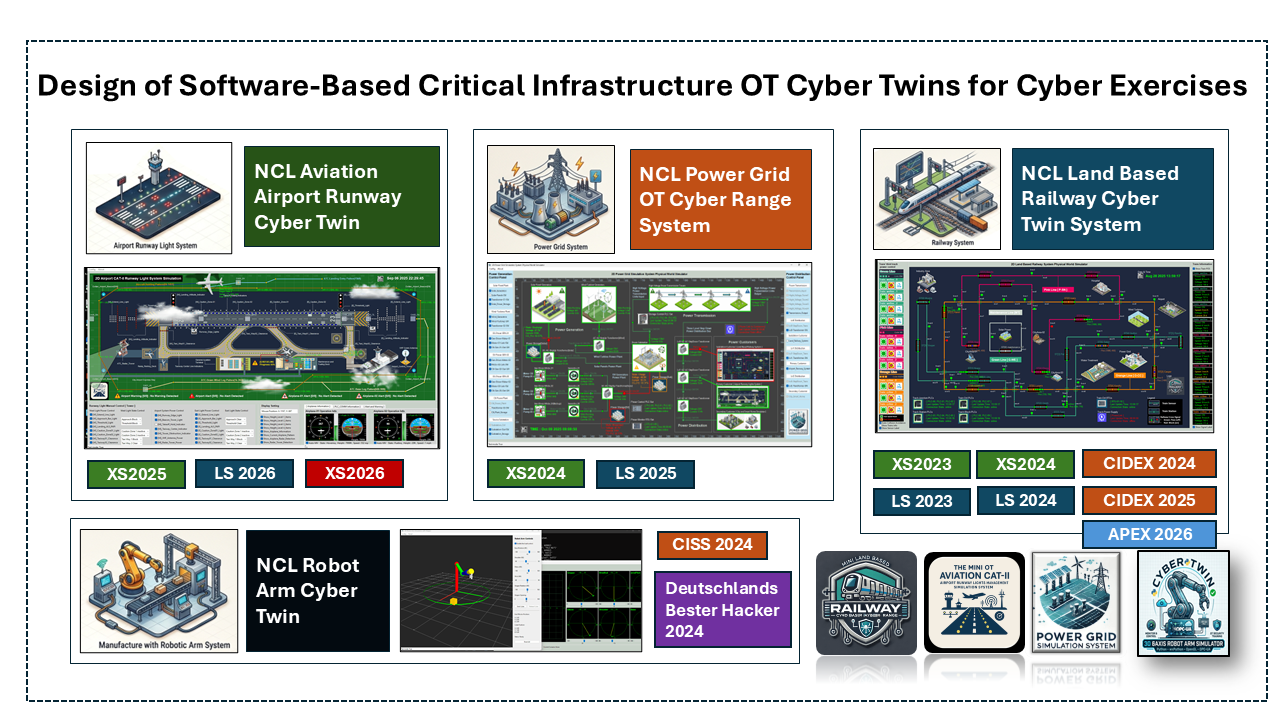
Design of Software-Based CI OT Cyber Twins for Cyber Exercises
Last month, I had the opportunity to present my work on “Design of Software-Based Critical Infrastructure (CI) OT Cyber Twins for Cyber Exercises” at the OT-ISAC Summit 2026 to provide an overview of the Software-Based Critical Infrastructure OT Cyber Twin systems (SBOCT) that I have been developing since 2023, highlighting how these OT simulation systems have been adopted and utilized in different international cybersecurity exercises. I also shared my experiences and lessons learned from continuously improving their design and implementation based on feedback and requirements from exercise organizers, participants, and users.
In this article, I would like to expand on the key concepts presented at the summit and provide more technical details about the design, development, deployment, and practical applications of these software-based OT cyber twins. I will also refer to several related articles I have previously published to provide additional technical insights and examples. The article is organized around the following key topics:
-
Introduction to Software-Based OT Critical Infrastructure Cyber Twins (SBOCT) – Concepts, definitions, and key advantages.
-
OT Cyber Twin Use Cases in International Cyber Exercises – How software-based OT cyber twins support different cybersecurity exercise scenarios.
-
Introduction to Different OT Cyber Twin Systems – An overview of the Railway, Power Grid, and Airport Runway Lighting cyber twin systems.
-
OT Cyber Twin System Design and ISA-95 Architecture – System architecture, design principles, and integration between IT and OT environments.
-
System Usage and Threat Detection (Blue Team) – How defenders interact with the cyber twin environment, monitor OT operations, and detect cyber threats.
-
System Configuration and Deployment (Green Team) – How exercise organizers configure, manage, and deploy the cyber twin environment for cyber exercises.
-
Cyberattack Scenarios and Case Studies (Red Team) – Practical examples of cyberattack scenarios targeting OT systems and their impact on critical infrastructure operations.
# Author:      Yuancheng Liu
# Created:     2026/10/8
# Version:     v_0.0.3
# Copyright:   Copyright (c) 2026 Liu Yuancheng
# License:     GNU General Public License V3
1. Introduction to Software-Based OT Critical Infrastructure Cyber Twins
The Software-Based OT Cyber Twins are designed to extend the capabilities of traditional physical OT testbeds, particularly for cybersecurity exercises and large-scale training activities. The diagram shows the key differences between the two approaches:
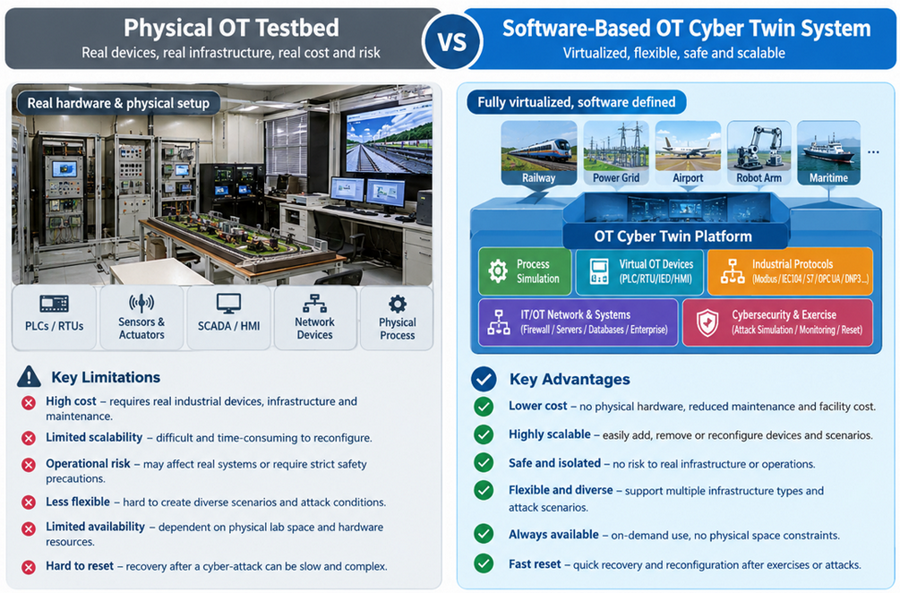
The objective is not to replace physical OT testbeds, but to complement and extend them to meet the requirements of modern cybersecurity exercises, particularly those involving multiple teams, distributed participation, large-scale deployment, and diverse cyberattack scenarios.
1.1 Why Do We Need Software-Based OT CI Cyber Twins
Physical OT testbeds equipped with real industrial hardware (such as sensors, actuators, PLCs, RTUs, motors, pumps, generators, and other industrial equipment) to provide realistic environments for studying industrial control systems, validating security solutions, and understanding the impact of cyberattacks on physical processes. However, despite their advantages, physical OT testbeds have some limitations when used for large-scale international cybersecurity exercises. For example :
-
Deploying a physical OT testbed for an international cyber exercise in other country can be challenging. Exercise organizers need to transport the entire testbed.
-
Cyber exercises often require multiple isolated copies of the same OT environment so that different teams can conduct attack and defense activities in parallel.
-
Cyber exercises may require participants to investigate and respond to incidents such as fires, train collisions, power failures, equipment malfunctions, or other abnormal operational conditions. Reproducing these scenarios using physical testbeds can be expensive, difficult to control, and potentially unsafe.
To address these challenges, a Software-Based OT Critical Infrastructure Cyber Twin (SBOCT) can extend the capabilities of traditional physical OT testbeds by providing a fully virtualized and software-defined environment.
1.2 What Is a Software-Based OT CI Cyber Twin
A Software-Based Critical Infrastructure OT Cyber Twin (SBOCT) is a software-defined virtual representation of a real-world critical infrastructure Operational Technology (OT) system. It is designed to reproduce the physical processes, control logic, industrial communication protocols, network architecture, device behaviors, and operational characteristics of the corresponding infrastructure within a controlled, configurable, and isolated digital environment.
-
Physical Process Model Simulation : Represents the physical infrastructure and its operational processes, such as railway operations, power generation and distribution, airport runway lighting, industrial machinery, and other critical infrastructure facilities. It simulates the operational states and behaviors of physical equipment and processes.
-
OT Device Model Simulation : Provides software-based representations of industrial devices, including PLCs, RTUs, Intelligent Electronic Devices (IEDs), sensors, actuators, motors, breakers, and other OT field controller equipment.
-
Industrial Communication Model Simulation : Implements industrial communication protocols and data exchanges between OT devices, control systems, and supervisory applications. Depending on the infrastructure requirements, supported protocols may include Modbus TCP, Siemens S7 Communication, IEC 60870-5-104, IEC 61850, OPC UA, MQTT, and other industrial communication standards.
-
OT Network and System Model Simulation : Reproduces the OT network infrastructure and supporting systems, including network segmentation, industry firewalls, servers, databases, enterprise applications, SCADA systems, Human-Machine Interfaces (HMIs), and other services.
2. OT Cyber Twin Use Cases in International Cyber Exercises
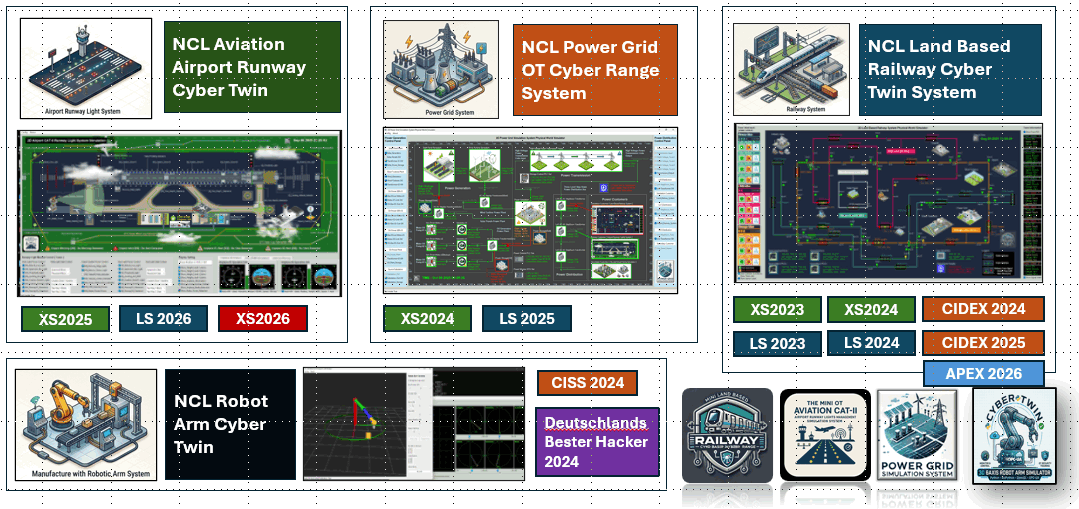
Over the past three years, the NCL has designed, developed, and deployed five different Software-Based OT Cyber Twin systems representing four various critical infrastructure environments sector (Railway Transport, Aviation, Manufacture, Energy). These include Land-Based Railway, Metro Railway Station, Aviation Airport Runway, Power Grid, and Industrial Robot Arm cyber twin systems.
These systems have been progressively utilized in various international cybersecurity exercises and events cross Europe and Asia for cybersecurity training, red team attack target (RT), blue defense operations (BT) , digital forensics (DF), incident response (IR), and Capture The Flag (CTF) challenges.
-
Crossed Swords (XS) and Locked Shields (LS) host in Europe
-
Allied Power Exercise (APEX) host in South Korea
-
Critical Infrastructure Defence Exercise (CIDEX) and Critical Infrastructure Security Showdown (CISS) host in Singapore
-
The Deutschland Bester Hacker host in Germany
2.1 Different Roles of OT Cyber Twins in Cyber Exercises
Depending on the objectives and technical requirements of each exercise, the OT cyber twin systems can serve different purposes and support multiple exercise roles.
-
Red Team (RT) – Cyberattack Targets : The OT cyber twin serves as a target environment for Red Team participant exploit vulnerabilities in OT networks, compromise virtual OT devices, manipulate industrial communication protocols, and attempt to disrupt or manipulate the underlying physical processes.
-
Blue Team (BT) – Cyber Defense and Threat Detection : Used for Blue Team participants to monitor industrial operations, investigate security alerts, identify abnormal OT network activities, and detect cyberattacks targeting critical infrastructure.
-
Digital Forensics and Incident Response (DFIR) – Investigation Data Generation : The cyber twin will used to simulated or repeat an OT attack scenario (such as the black energy attack) in a time period, then collect the data of network traffic, system logs, industrial protocol communications, process status changes, and other relevant forensic artifact will be recorded for the team to analyse attack activities, reconstruct incident timelines, identify compromised systems.
-
Capture The Flag (CTF) – OT Security Challenges : The OT cyber twin can be integrated into CTF challenges to provide hands-on OT cybersecurity competition. Participants can investigate industrial protocols, analyse OT device behaviour, identify vulnerabilities, manipulate simulated control systems, and solve challenges related to critical infrastructure operations.
2.2 OT Cyber Twin Deployment History and Use Cases
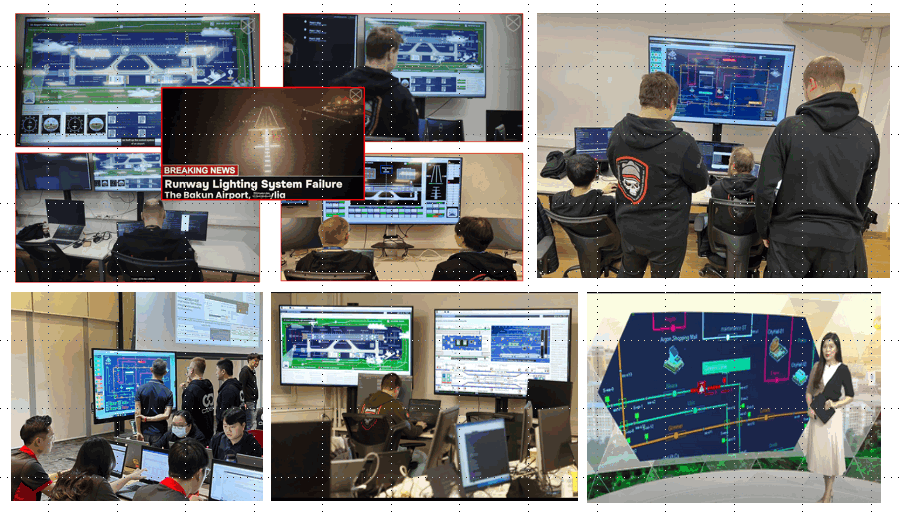
The following table summarizes the deployment and utilization of the five OT cyber twin systems in different international cybersecurity exercises and events over the past three years. Below are some picture published by cyber exercise which shows the usage of the cyber twins system:
| OT Cyber Twin System | Critical Infra Sector | Version | Cyber Exercise / Event | Year | Exercise Role |
|---|---|---|---|---|---|
| Land Based Railway Cyber Twin System | Transport | V_0.1.3 | Crossed Swords | 2023 | RT |
| V_0.1.4 | Locked Shields | 2023 | DFIR | ||
| V_1.2.2 | Crossed Swords | 2024 | RT | ||
| V_1.0.6 | Locked Shields | 2024 | DFIR | ||
| V_2.0.1 | CIDEX | 2024 | RT + BT | ||
| V_2.0.2 | CIDEX | 2025 | RT + BT | ||
| V_2.0.3 | APEX | 2026 | RT + BT | ||
| Smart Power Grid OT Cyber Twin System | Energy | V_0.2.1 | Crossed Swords (combined with Railway) | 2024 | RT |
| V_1.0.1 | Locked Shields | 2025 | DFIR | ||
| Aviation Airport Runway Cyber Twin System | Aviation | V_0.1.1 | Crossed Swords | 2025 | RT |
| V_1.1.1 | Locked Shields | 2026 | DFIR | ||
| V_2.1.1 | Crossed Swords | 2026 | RT | ||
| Metro Railway Station Cyber Twin Simulation System | Transport | V_0.1.3 | Crossed Swords | 2026 | RT |
| Industrial Robot Arm Cyber Twin System | Manufacture | V_0.1.2 | CISS | 2024 | CTF |
| V_0.1.1 | Deutschland Bester Hacker | 2024 | CTF |
3. Aviation CAT-II Airport Runway Management Cyber Twin
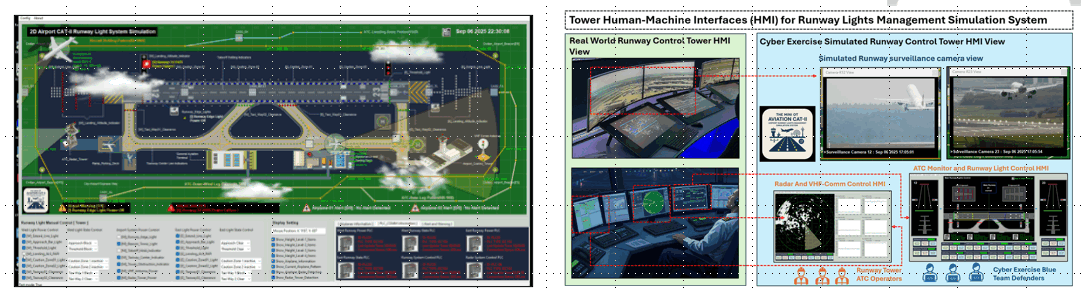
The Mini OT Aviation CAT-II Airport Runway Lights Management Simulation Cyber Twin is a compact software-based OT cyber-range platform developed to simulate a civilian Category II (CAT-II) precision instrument runway environment. Designed for cybersecurity exercises, technical training, and educational purposes, the system reproduces a four-level OT environment, from Level 0 physical runway equipment and field devices to Level 3 Operations Management systems, following the general design principles of the Federal Aviation Administration (FAA) Air Traffic Control (ATC) architecture. The UI view of the cyber twin is shown below:
3.1 Cyber Twin System Introduction
The cyber twin integrates three major SCADA subsystems that support airport tower operations:
-
CAT-II Runway Lights Management System: Simulates 11 types of tower-controlled runway lighting systems and visual indicators, including Instrument Landing System (ILS) and Approach Lighting System (ALS), supporting aircraft landing, takeoff, and taxiing operations.
-
Weather and Aircraft Tracking Radar System: Simulates airport weather monitoring, aircraft surveillance radar, and radar data visualization for monitoring weather conditions and aircraft positions.
-
VHF, UHF, and ADS-B Communication System: Simulates aircraft communication and surveillance functions, including pilot-to-tower VHF radio communication and ADS-B aircraft tracking.
3.2 System Architecture and Related Documents
The overall system architecture follows the ISA-95 model as shown below, covering the OT infrastructure from physical processes (Level 0) through control and supervisory systems to the Operations Management Zone (Level 3).
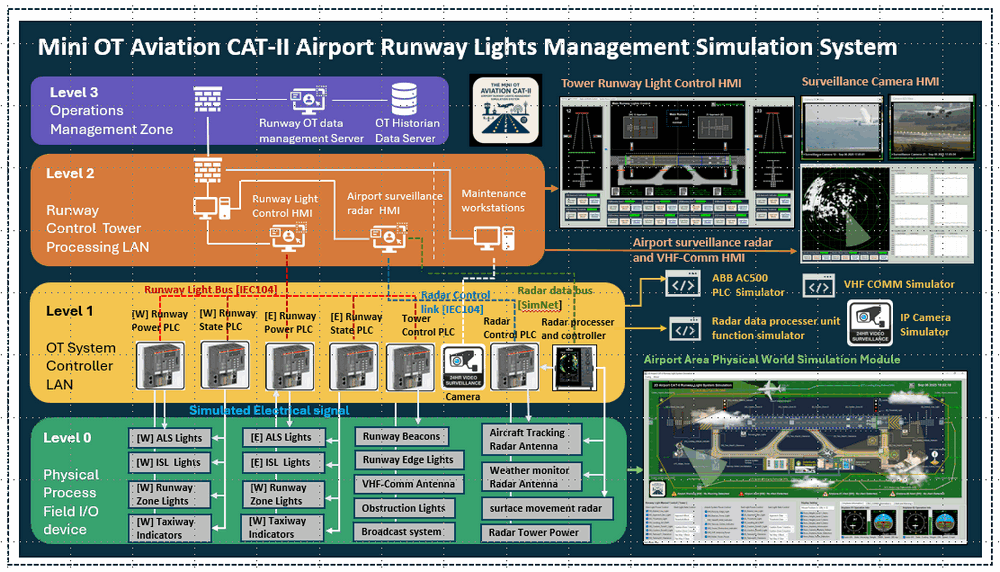
By integrating runway lighting control, radar surveillance, weather monitoring, and aircraft communication into a unified software-based environment, the system provides a realistic OT cyber twin for studying cybersecurity threats and their operational impacts on airport runway and ATC operations.
Related Technical Documentation:
-
The detailed introduction document : https://www.linkedin.com/pulse/aviation-runway-lights-management-simulation-system-yuancheng-liu-5rzhc
-
The system document Wiki repo: https://github.com/LiuYuancheng/Airport_Runway_Simulation_Cyber_Range_Document
4. Land-Based Railway Signalling System IT-OT Cyber Twin
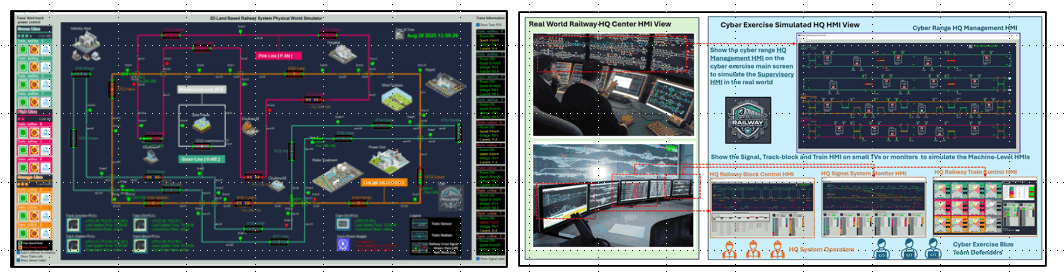
The Land-Based Railway Simulation Cyber Range System (Cyber Twin) is a fully digital, distributed cybersecurity platform developed to simulate a railway company's integrated six-level IT and OT environment. It provides a comprehensive software-based representation of railway infrastructure, covering physical railway operations, track signalling, Automatic Train Control (ATC), Automatic Train Protection (ATP), station automation, and supporting enterprise IT systems, including railway ticketing web applications. The UI view of the cyber twin is shown below:
4.1 Cyber Twin System Introduction
The system integrates multiple railway OT subsystems to reproduce realistic railway operational scenarios, as illustrated in Figure X. Its major components include:
-
Railway Tracks and Signalling: Simulates three interconnected railway lines (Green Line, Pink Line, and Orange Line) with a fixed-block signalling and ATP system, comprising 67 train position detection sensors and 31 railway signals.
-
Station Management and Automation: Simulates 22 railway stations with automatic train docking, departure, and platform management functions, including 44 sensors, 44 signals, and 88 passenger platform screen doors.
-
Train and Third-Rail Power System: Simulates 10 trains and their third-rail power supply infrastructure, with 40 onboard sensors (four per train) and 20 latching relays.
-
PLC/RTU/MU Controller Simulation: Implements four types of OT controller configurations, including 8 track PLCs using Modbus TCP, 2 station PLCs using IEC 60870-5-104, and 10 train RTUs connected to 60 Measurement Units (MUs) using Siemens S7 Communication (S7Comm).
-
Operator HMI Systems: Provides train driver control interfaces and three railway Operations Control Centre (OCC) operator HMIs for track, station, and train management.
-
Centralized Monitoring HMI: Provides an integrated control centre monitoring interface for observing railway operations and the overall system status.
4.2 System Architecture and Related Documents
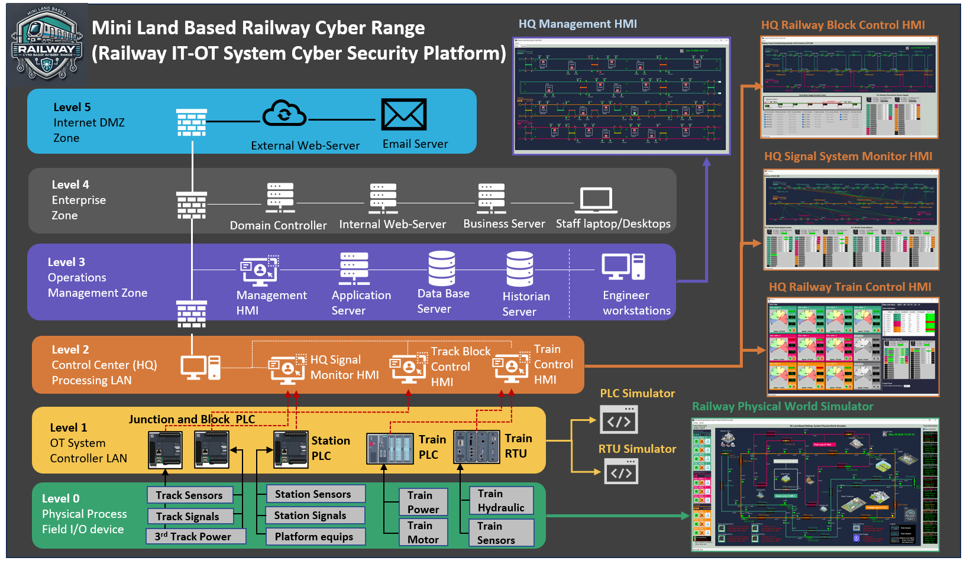
The overall system architecture follows the ISA-95 model, integrating railway physical processes, field controllers, supervisory control systems, and enterprise IT infrastructure across six levels as shown below:
Related Technical Documentation:
-
The system document Wiki repo: https://github.com/LiuYuancheng/Land_Based_Railway_Simulation_Cyber_Range_Document
5. Power Grid OT Energy System Cyber Twin
The Mini OT Power Grid Simulation System (Cyber Twin) is a digital equivalent software platform designed to simulate the core operations of a hybrid power grid system, including hybrid power generation (natural gas power plants, solar power plants, and wind turbine farms), energy storage system, high-voltage power transmission and a three-level step-down power distribution system. The simulation integrates a SCADA system that incorporates PLCs for remote system control, IIoT, RTUs and MUs for real-time data monitoring, and an HMI interface for operators to manage the grid. . The key components of an electrical grid are divided into three main parts: generation and storage, transmission, and distribution. The UI view of the cyber twin is shown below:
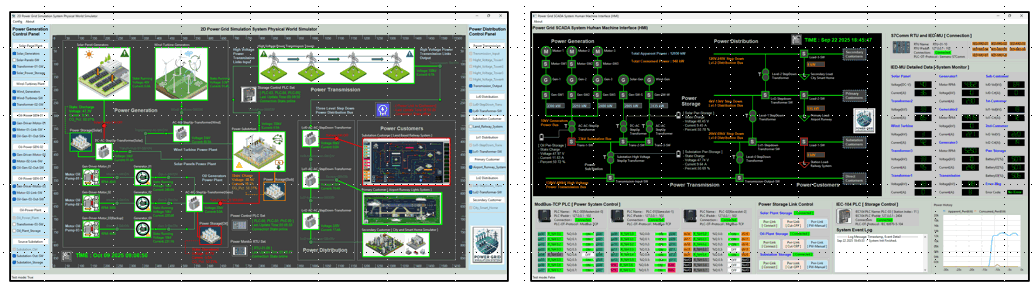
5.1 Cyber Twin System Introduction
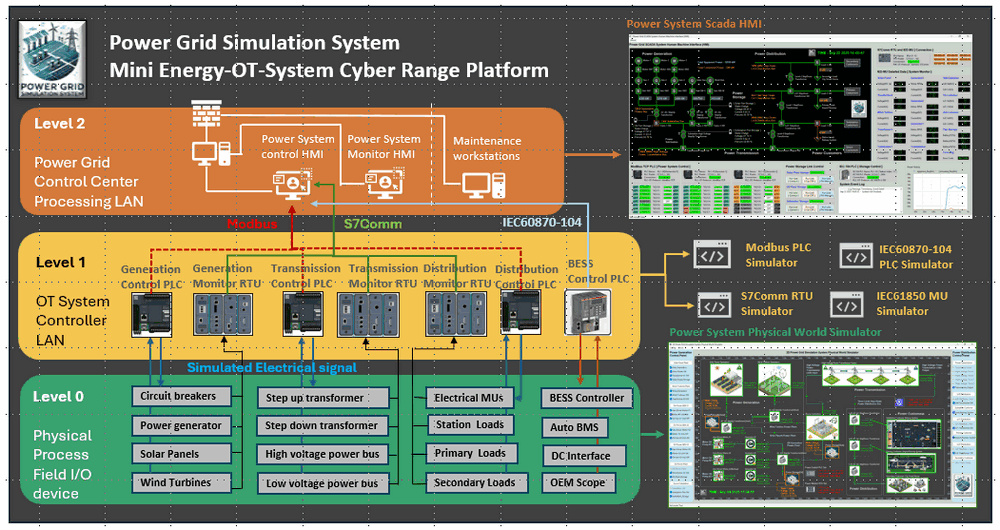
The cyber twin integrates industrial control and monitoring components to simulate realistic power grid operations, including PLCs for remote equipment control, Industrial Internet of Things (IIoT) devices, Remote Terminal Units (RTUs), and Metering Units (MUs) for real-time operational data acquisition and monitoring. A centralized SCADA-HMI system provides operators with supervisory control, grid status visualization, and operational management capabilities, as illustrated in Figure X.
The system architecture consists of three primary simulation modules:
-
2D Physical Process Visualization: Simulates the physical components and operational behaviors of the power grid, including power generation facilities, energy storage units, transmission lines, transformers, circuit breakers, and distribution networks.
-
OT Field Controller Simulation: Provides software-based simulation of PLCs, sensors, Metering Units (MUs), and Remote Terminal Units (RTUs), enabling communication and interaction between the simulated physical processes and supervisory control systems.
-
SCADA-HMI System: Provides centralized supervisory control, real-time monitoring, and visualization of power grid operations, allowing operators to monitor equipment conditions, manage power distribution, and respond to abnormal operating conditions.
5.2 System Architecture and Related Documents
The overall system architecture follows the ISA-95 model as shown below:
Related Technical Documentation :
-
The detailed introduction document : https://www.linkedin.com/pulse/power-grid-ot-simulation-system-yuancheng-liu-dpplc
-
The system document Wiki repo: https://github.com/LiuYuancheng/Power_Grid_Simulation_System_Document
6. Metro Railway Station Cyber Twin
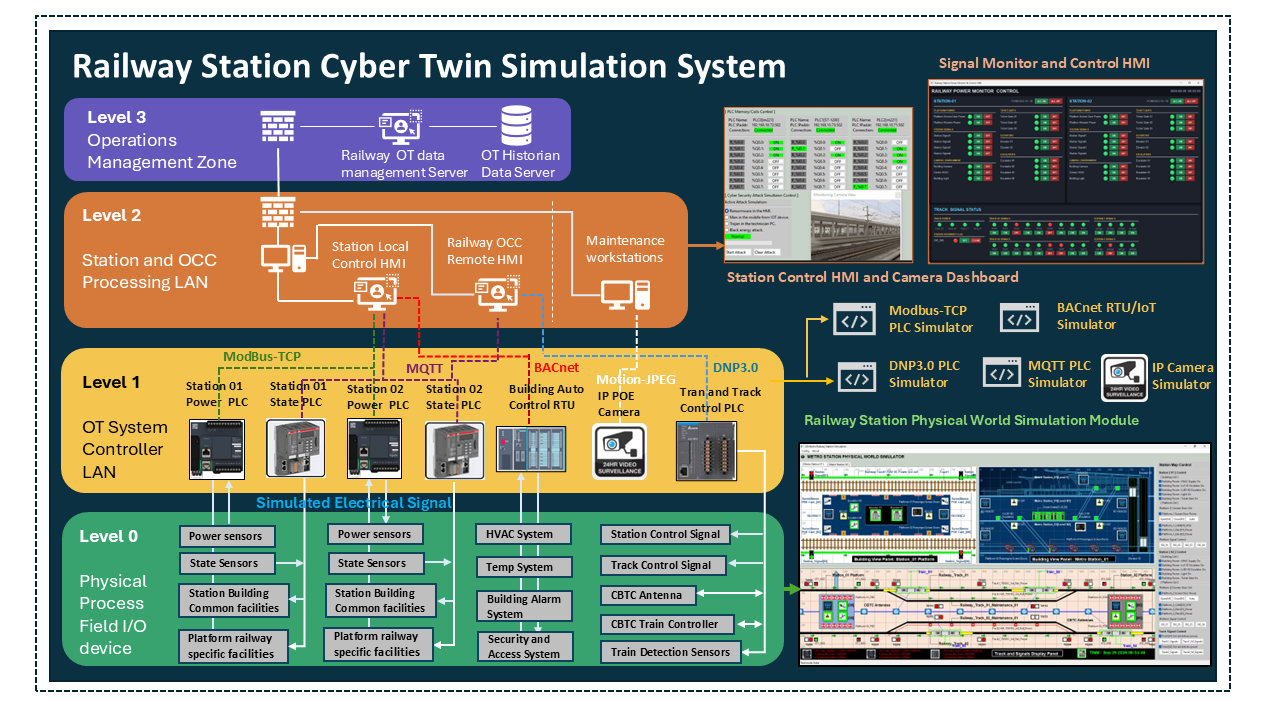
The Metro Railway Station Cyber Twin Simulation System (Cyber Twin) is a software-based OT simulation platform developed to model the operations of two interconnected underground metro railway stations and the railway tracks connecting them. The system integrates railway signalling, train control, station building automation, and platform management into a unified cyber twin environment. Designed for cybersecurity exercises, technical training, security research, and educational purposes, the platform provides an interactive digital representation of metro railway infrastructure and its associated Supervisory Control and Data Acquisition (SCADA) systems. The UI view of the cyber twin is shown below:
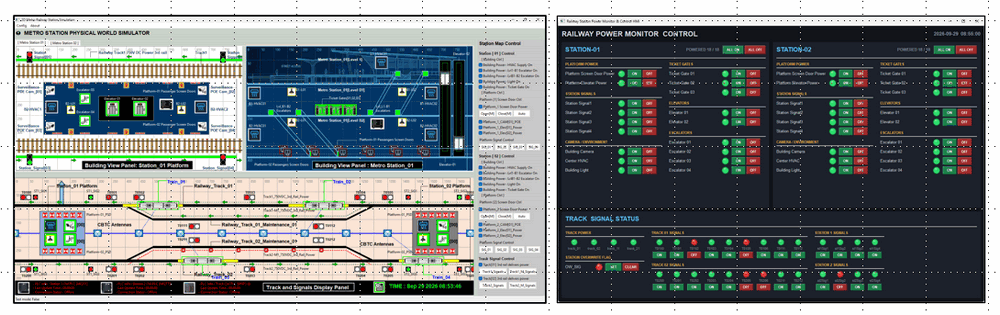
6.1 Cyber Twin System Introduction
The cyber twin simulates four major SCADA subsystems supporting metro Operations Control Centre (OCC) operations and station management:
-
Station Building Management System: Simulates two underground metro stations and their building automation facilities, including lighting, HVAC, elevators, ticket gates, station ventilation systems, and various alarm systems.
-
Station Platform Management System: Simulates platform equipment and passenger management functions, including automatically controlled platform screen doors, train detection sensors, surveillance cameras, people-counting radar, broadcast systems, and tunnel ventilation systems.
-
Railway Track and Signalling System: Simulates four railway tracks connecting the two stations, consisting of two operational tracks and two maintenance tracks. The system also incorporates a 750 V DC third-rail traction power supply, track-fork-switch control, railway signalling equipment, and trackside train detection sensors.
-
Communication-Based Train Control (CBTC) System: Simulates multiple trains operating between the two stations according to train schedules, track conditions, and signalling information. A simplified moving-block CBTC model supports automatic speed adjustment, train movement coordination, and Automatic Train Protection (ATP) for multiple trains sharing the same track.
6.2 System Architecture and Related Documents
The overall system architecture follows the ISA-95 model as shown below:
Related Technical Documentation :
-
The detailed introduction document : https://www.linkedin.com/pulse/metro-railway-station-cyber-twin-simulation-system-yuancheng-liu-lhsic
-
The system document Wiki repo : https://github.com/LiuYuancheng/Metro_Railway_Station_CyberTwin_System_Document
7. Industrial Robot Arm Cyber Twin
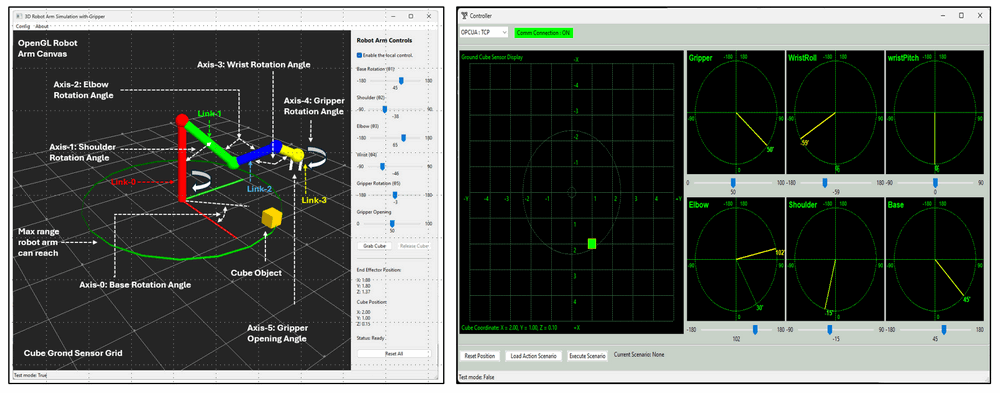
The Industrial Robot Arm Cyber Twin Simulation System is a software-based cyber-physical simulation platform developed to reproduce the operation of a 3D six-axis industrial robotic arm within an OT environment. Developed using Python, wxPython, OpenGL, and the OPC-UA TCP communication protocol, the system integrates 3D physical process visualization, virtual industrial control, and remote supervisory operation into a unified simulation environment. The UI view of the cyber twin is shown below:
7.1 Cyber Twin System Introduction
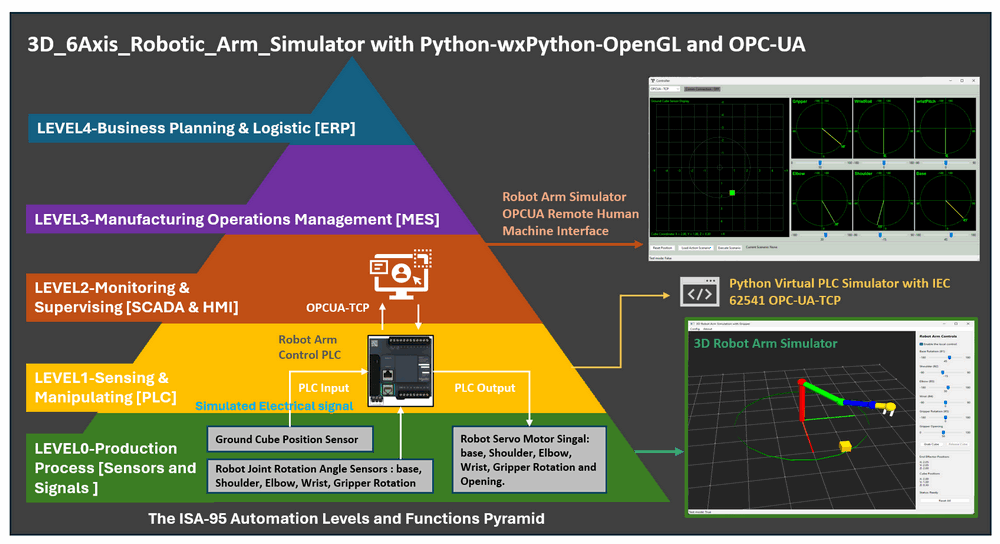
The system design follows the international ISA-95 (IEC/ISO 62264) automation architecture, bridging the gap between virtual robotic simulation and industrial automation. The current implementation focuses on three main modules corresponding to ISA-95 Levels 0–2:
-
Robot Arm Simulator (Level 0 – Field Level): Provides a 3D OpenGL-based visualization of the six-axis robotic arm and simulates its physical components, including position sensors, servo motors, and tactile sensors. It supports interactive robotic operations such as object manipulation and pick-and-place tasks, together with a local control panel for manual operation and real-time status visualization.
-
Robot Arm OPC-UA PLC (Level 1 – Control Level): Implements a software-based industrial PLC that processes sensor information from the robot arm simulator and generates corresponding motor control commands. It provides the control logic required to coordinate robotic movements and support autonomous or semi-autonomous operations through OPC-UA communication.
-
User Remote HMI Controller (Level 2 – Supervisory Level): Provides a remote Human-Machine Interface (HMI) for operators to monitor robotic arm telemetry and execute control commands over the network through the OPC-UA protocol.
7.2 System Architecture and Related Documents
The overall system architecture follows the ISA-95 model as shown below:
Related Technical Documentation :
-
The detailed introduction document : https://www.linkedin.com/pulse/3d6axisroboticarmsimulator-python-wxpython-opengl-opc-ua-liu-hunnc
-
The system document Wiki repo : https://github.com/LiuYuancheng/Python_3D_6Axis_Robotic_Arm_Simulator
8. Cyber Twin System Setup and Usage in Cyber Exercises
A Software-Based OT Cyber Twin is designed to support different operational requirements throughout a cybersecurity exercise. Depending on their responsibilities, the Green Team, Blue Team, and Red Team interact with the cyber twin environment in different ways.
This section introduces the typical system setup, deployment procedures, and operational workflows for each team, demonstrating how the cyber twin platform supports the preparation, execution, and evaluation of OT cybersecurity exercises.
| Team | Primary Responsibility | Cyber Twin Usage |
|---|---|---|
| Green Team | Infrastructure configuration and exercise management | Deploy, configure, replicate, monitor, and restore OT cyber twin environments |
| Blue Team | Cyber defense and incident response | Monitor OT operations, analyze network traffic, detect threats, and investigate incidents |
| Red Team | Cyberattack simulation | Discover vulnerabilities, conduct controlled attacks, manipulate OT components, and demonstrate operational impacts |
8.1 System Configuration and Deployment (Green Team)
The Green Team is responsible for preparing, configuring, deploying, and maintaining the cyber exercise infrastructure. The Software-Based OT Cyber Twin provides a flexible and reusable platform that allows exercise organizers to configure different critical infrastructure environments according to the exercise objectives.
The typical deployment workflow includes:
-
Cyber Twin Environment Selection: Select the required OT cyber twin system, such as Railway, Power Grid, Airport Runway, Metro Station, or Industrial Robot Arm, according to the exercise scenario.
-
Virtual Infrastructure Deployment: Deploy the required virtual machines, including physical process visualization, PLC/RTU simulations, SCADA/HMI systems, and supporting IT services.
-
Network Configuration: Configure the IT/OT network architecture, network segmentation, virtual switches, IP addressing, routing, and firewall policies to establish the required exercise environment.
-
Team Environment Preparation: Configure network access and isolated cyber twin instances for different participating teams, including Red Team attack environments and Blue Team monitoring environments.
-
Scenario and Initial State Configuration: Initialize the physical process conditions, OT device states, controller parameters, and system configurations according to the exercise scenario.
-
System Validation and Recovery: Verify communication between simulation modules, industrial protocols, and HMI systems. Prepare system snapshots, backup configurations, and recovery procedures for exercise restoration.
This is an example to setup the aviation platform :
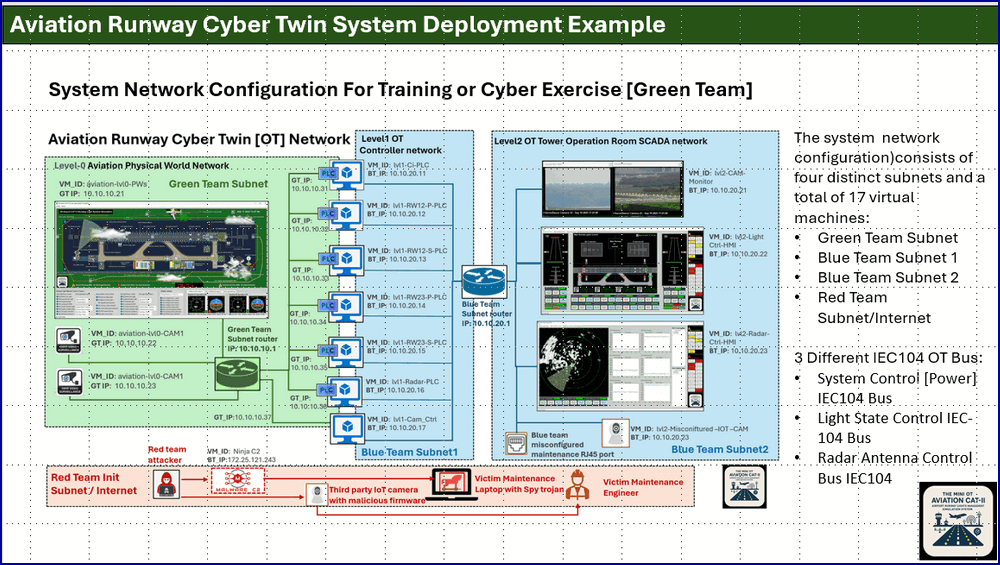
Through software-based deployment and virtualization, the Green Team can replicate multiple independent OT environments, modify infrastructure configurations, and restore the cyber twin to its initial operational state without manually rebuilding physical equipment.
8.2 System Usage and Threat Detection (Blue Team)
The Blue Team uses the OT cyber twin as an operational environment for cybersecurity monitoring, threat detection, and incident response. Unlike conventional IT cybersecurity exercises, the cyber twin allows defenders to observe both network-level activities and their corresponding impact on industrial processes.
The typical Blue Team workflow includes:
-
OT Operational Monitoring: Monitor the physical process visualization, SCADA/HMI dashboards, PLC/RTU states, sensor values, and equipment operating conditions.
-
Network Traffic Monitoring: Capture and analyze IT/OT network traffic to identify suspicious communication patterns, unauthorized connections, and abnormal industrial protocol activities.
-
Industrial Protocol Analysis: Monitor communication protocols such as Modbus TCP, Siemens S7Comm, IEC 60870-5-104, IEC 61850, and OPC UA to identify unauthorized commands, abnormal data exchanges, and suspicious device interactions.
-
Threat Detection and Investigation: Correlate network security alerts, system logs, controller states, and physical process changes to identify potential cyberattacks and investigate their operational impact.
-
Incident Response: Analyze affected OT components, identify compromised systems, determine the scope of the incident, and coordinate appropriate response and recovery actions.
One of the main advantages of the software-based OT cyber twin is that defenders can observe the relationship between cyber activities and physical process behavior. For example, an unauthorized PLC command may not only appear as suspicious network traffic but may also result in a change in railway signalling status, power grid breaker conditions, airport runway lighting, or robotic arm movements.
This is an example to detect the possible attack:
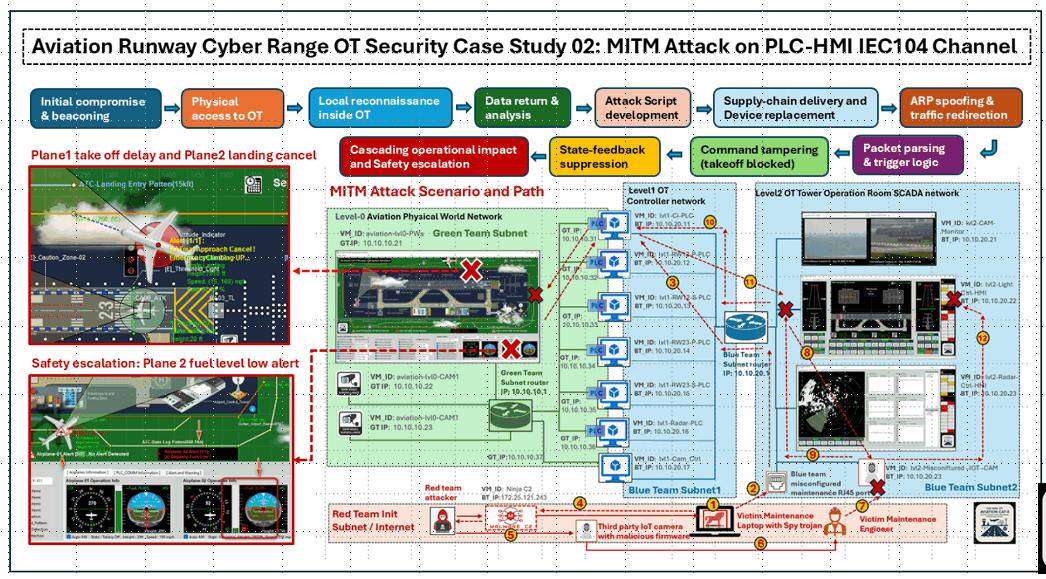
Related document link: https://www.linkedin.com/pulse/aviation-runway-cyber-range-ot-security-case-study-02-yuancheng-liu-ch2cc
This provides Blue Team participants with an opportunity to practice identifying and investigating cyber threats from both IT/OT security and industrial operational perspectives.
8.3 Cyberattack Scenarios and Case Studies (Red Team)
The Red Team uses the OT cyber twin as a controlled target environment to conduct cyberattack simulations against critical infrastructure systems. The objective is to identify security weaknesses, exploit vulnerable IT/OT components, manipulate industrial communication, and demonstrate the potential operational impact of cyberattacks.
Depending on the selected infrastructure and exercise objectives, Red Team activities may include:
-
IT/OT Network Reconnaissance: Discover network assets, identify exposed services, and map communication relationships between IT and OT systems.
-
Industrial Protocol Attacks: Investigate industrial communication services and simulate unauthorized reading, writing, or manipulation of OT device parameters.
-
Controller and HMI Compromise: Simulate attacks against PLCs, RTUs, SCADA/HMI systems, and their supporting services.
-
Process Manipulation: Modify simulated sensor values, control commands, equipment states, or operational parameters to generate abnormal industrial conditions.
-
Operational Disruption: Demonstrate the potential consequences of cyberattacks, such as railway signalling failures, abnormal train movements, power grid disruptions, runway lighting failures, or unexpected robotic arm movements.
This is an example for the red team to attack the railway system:
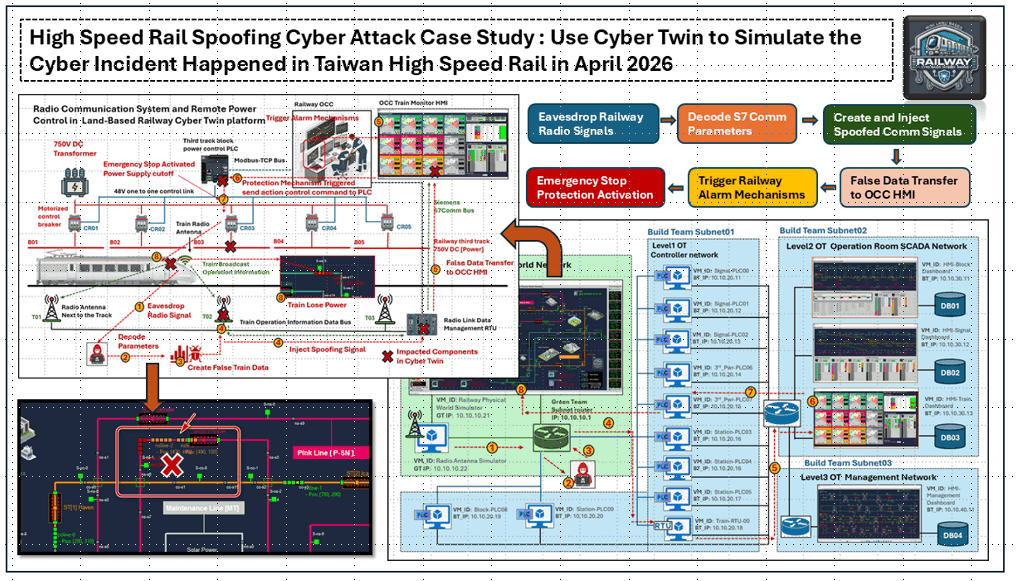
Related document link : https://www.linkedin.com/pulse/rail-ot-spoofing-cyber-attack-case-study-use-twin-simulate-liu-dfmqc
Thanks for spending time to check the article detail, if you have any question and suggestion or find any program bug, please feel free to message me. Many thanks if you can give some comments and share any of the improvement advice so we can make our work better ~

No comment for this article.