
Ask what Meta Quest 4 will do and most answers reach for pixel counts and a launch window. Both are guesses. For people who write software rather than read spec sheets, a better question is narrower: which capabilities have real technical evidence behind them, and how strong is it?
Meta itself has confirmed almost nothing. What exists instead are scattered harder signals: a chipset launch from Meta's silicon partner, peer-reviewed input research, firmware strings pulled apart by dataminers, and a developer platform quietly shipping features that hint at the hardware's direction. None of it is hidden, just spread across sources rarely read together.
What do we actually know about Meta Quest 4?
Officially, very little. Meta has not announced a name, a spec sheet, a price or a date.
The firmest on-record signal came in February 2026, when CTO Andrew Bosworth told journalist Alex Heath that two devices sit on the roadmap. He repeated the point in July, pointing to Connect in September.
Past that, it is reporting. UploadVR, working from leaked December 2025 memos it independently authenticated, describes two products: an ultralight headset with a tethered compute puck, and a gaming-focused successor codenamed Griffin. That split matters, because many leaks describe the ultralight device, not the gaming headset.
1. Scene reconstruction without a dedicated depth sensor
The strongest new technical evidence this year did not come from Meta. In June 2026 Qualcomm announced Snapdragon Reality Elite, whose expanded EVA block (Engine for Visual Analytics) accelerates computer vision work such as 3D environment reconstruction. Asked by UploadVR whether it could support real-time continuous scene meshing without a depth sensor, Qualcomm indicated it could, leaving implementation to developers.
Confirmed: the chipset and its stated capabilities. Not confirmed: that any Meta headset uses it. Meta has shipped semi-custom Snapdragon parts before, so reading across is unsafe.
Current Quest mixed reality treats a room as scanned once, then static. Continuous meshing would let geometry update as a chair moves, turning occlusion and collision into runtime concerns.
2. Generative models running on the headset itself
Same chipset, different block. Qualcomm claims a 160% NPU uplift over its previous flagship, reaching 48 TOPS, and gives two figures: a three billion parameter language model at roughly 45 tokens per second, and a 512 by 512 vision model at around 1.7 seconds latency. Those are vendor benchmarks for silicon, not a Meta Quest 4 promise.
The useful part is the shape of the constraint. Forty-five tokens per second is comfortable for a short NPC line and awkward for a monologue. A 1.7 second vision pass suits an object lookup triggered by user action, not a per-frame classifier. That budget could still support local dialogue and recognition with no network round trip.
3. Camera access is already a platform primitive
This one is easy to miss because it is not a rumour. It shipped.
Meta's Passthrough Camera API reached public release in Horizon OS v76 and exposes the forward-facing RGB cameras on Quest 3 and Quest 3S through the standard Android Camera2 API. It covers Unity, Unreal, native and Spatial SDK paths, gates access behind a dedicated headset camera permission, and captures a 1280 by 960 texture, smaller than the wearer sees.
So the open question for the next headset is not whether developers get camera frames, but what resolution, latency and permission model they inherit. Teams building computer vision pipelines for VR training or industrial simulation can prototype against today's API and expect better inputs later, not a new paradigm.
4. Eye tracking, and why the firmware trail points elsewhere
Eye tracking is the feature most often pinned to Meta Quest 4 rumours. The evidence is real but frequently misattributed.
Firmware dataminers Luna and Samulia, whose findings UploadVR reported in February 2026, recovered low-resolution images of Meta's next headset from Quest firmware and ran its eye tracking calibration flow on a Quest Pro. Luna had earlier surfaced strings referencing automatic IPD adjustment and iris unlock, both gaze-dependent.
The finding is credible, but it describes Phoenix, the ultralight tethered device, not the gaming successor. Citing it as proof of Quest 4 eye tracking reads across two products.
The payoff would be eye-tracked foveated rendering, concentrating shading where the fovea points and freeing GPU headroom. Quest Pro shipped eye tracking; the Quest 3 family did not.
5. sEMG input, with a bridge already on Quest
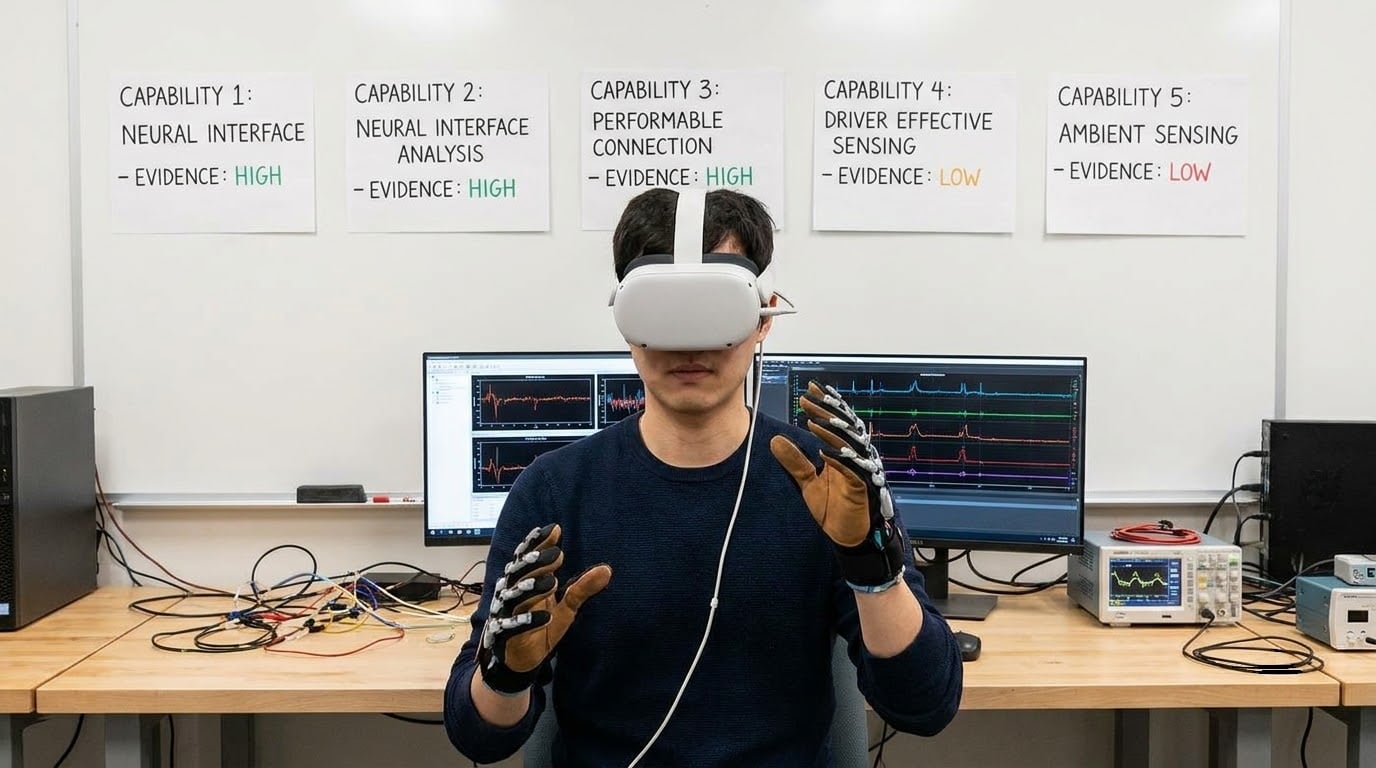
Meta's surface electromyography work is peer reviewed and already productised, unusual for something that sounds this futuristic. Reality Labs published its wrist-based neuromotor interface research in Nature in July 2025, and the resulting Meta Neural Band shipped with Ray-Ban Display glasses that September. Meta's EMG page frames the band as input for those glasses and the next generation of computing platforms.
No Quest integration has been announced.
What lifts this above speculation is that a compatible interaction grammar already exists. Meta’s microgestures OpenXR extension, available via Meta XR Core SDK v74 and later on Quest 2, Quest Pro and the Quest 3 family, exposes a thumb tap plus four directional thumb swipes as discrete inputs.
Why these could matter to developers
Two themes cut across the list. Perception is moving from a setup step to a runtime service: scene understanding, camera frames and on-device inference all point toward apps that keep interpreting a room rather than trusting one scan. Input is drifting from the tracked controller toward smaller gestures a wrist sensor would make effortless.
Neither theme requires waiting. Camera access, microgestures and Meta's scene and anchor APIs run on current hardware today.
What remains unconfirmed?
Nearly all of the hardware. Meta has not confirmed the Quest 4 name, chipset, displays, eye tracking, price or ship date. Reporting places the ultralight headset in the first half of 2027 and the gaming successor later, with some observers hedging toward 2028. The roadmap has reversed once already, so confident spec claims deserve scepticism.
Final takeaway
Sort Meta Quest 4 coverage into three buckets: confirmed platform capability, announced partner silicon, and reported hardware. Only the first is safe to build on. The second tells you what is plausible. The third is where the noise lives. Connect on September 23 is the next checkpoint.

No comment for this article.