
AWS costs escalate unexpectedly due to complex pricing models, misconfigurations, and inefficient resource usage. This report provides comprehensive strategies to reduce AWS expenses while maintaining performance, focusing on data transfer optimization, resource management, and service-specific techniques.
Understanding AWS Cost Drivers
Data Transfer Expense Analysis
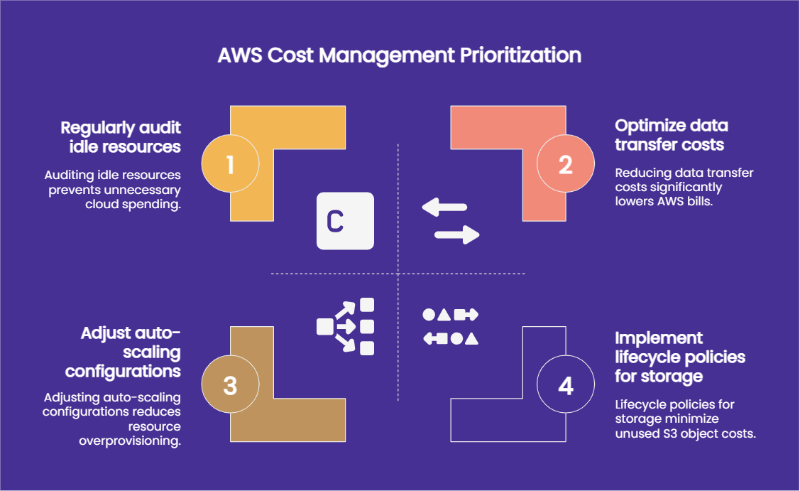
Data transfer costs significantly impact AWS bills through inter-region, cross-AZ, and internet egress charges, contributing to overall cloud infrastructure expenses. Transfers within the same region but across availability zones incur fees of $0.02/GB, creating substantial expenses for high-traffic applications. Internet egress costs range from $0.05 to $0.09 per GB in regions like EU and USA, accumulating quickly for data-intensive workloads. Organizations often overlook these expenses when designing multi-region architectures, resulting in budget overruns during scaling operations and leading to unnecessary cloud spend. Inbound transfers remain free across all AWS regions, making import operations cost-effective compared to export processes.
Idle Resource Impact
Unattached EBS volumes and stopped EC2 instances continuously generate charges despite providing no business value. EBS volumes incur costs even when associated EC2 instances are stopped, silently inflating monthly bills unless manually deleted or optimized through snapshots, leading to thousands of dollars wasted. Unused S3 objects and failed multi-part uploads similarly contribute to unnecessary storage expenses when not properly managed through lifecycle policies. Organizations waste thousands annually on forgotten or abandoned resources that provide no computational benefit, unnecessarily increasing their cloud bill. Regular auditing identifies these resource drains, enabling significant cost reductions without performance impacts.
Auto-scaling Configuration Problems
Improperly configured auto-scaling groups overprovision resources, increasing costs without improving performance. Scaling policies misaligned with actual workload patterns provision excess instances during periods of minimal traffic, generating wasteful infrastructure spending and leading to overpaying. Using Lambda for predictable, continuous workloads typically costs more than properly sized EC2 instances with reserved pricing. Auto-scaling thresholds set too aggressively trigger unnecessary scaling events, creating cost spikes during minor traffic fluctuations. Optimization requires analyzing actual usage patterns and adjusting scaling parameters based on real-world performance requirements.
Leveraging Reserved Instances
Reserved Instance Types Comparison
Reserved Instances reduce AWS costs by up to 72% compared to on-demand pricing through upfront commitment. Standard RIs provide maximum discounts but limit flexibility in changing instance attributes, while Convertible RIs offer slightly lower savings with greater modification options across instance families. Savings Plans represent a newer alternative, delivering similar cost benefits while extending flexibility across multiple AWS services, helping organizations manage their cloud effectively. Three-year commitments maximize discount percentages but increase lock-in risk if workload requirements change unexpectedly. Organizations should evaluate their tolerance for commitment against potential savings when selecting between reservation options.
Workload Matching Strategies
Precise workload alignment with Reserved Instance types maximizes cost savings while ensuring performance. Heavy utilization RIs deliver optimal value for applications running 24/7, such as production databases or core business systems. Medium or light utilization RIs better suit development environments or batch processing workloads with intermittent usage patterns. AWS's rightsizing recommendations identify optimal instance types based on historical usage data, preventing overprovisioning expenses. Regular workload analysis ensures RI purchases match actual resource requirements rather than projected or estimated needs.
Savings Calculation Methodology
Reserved Instance savings depend on commitment duration, payment option, and utilization consistency. One-year commitments typically reduce costs by 40-50%, while three-year terms can achieve 60-72% savings compared to on-demand rates. Partial upfront payment options balance immediate costs with long-term savings, delivering stronger ROI than no-upfront alternatives. AWS provides calculators for estimating potential savings based on specific usage patterns and instance types, enabling accurate financial planning. Organizations should incorporate future growth projections when calculating reserved capacity requirements to prevent shortfalls.
Cost Management Tools
Cost Explorer Optimization Techniques
AWS Cost Explorer reveals spending patterns and provides actionable rightsizing recommendations. The tool visualizes costs across multiple dimensions, enabling identification of which services contribute most significantly to monthly bills. Filtering capabilities expose unnecessary expenses by region, service, or tag, highlighting cost optimization opportunities. Cost Explorer's rightsizing recommendations identify oversized EC2 instances, potentially reducing compute expenses by 10-30% without performance impact. Custom budget alerts prevent overspending by notifying stakeholders before costs exceed predetermined thresholds.
Anomaly Detection Implementation
Cost Anomaly Detection identifies unusual spending patterns before they significantly impact budgets, allowing organizations to manage their cloud spend proactively. Machine learning algorithms detect unusual expense spikes, such as unexpected data transfer surges from misconfigured applications. Customizable detection models target specific services or accounts with unique usage patterns, preventing false positives. Early detection prevents minor configuration issues from creating major budget impacts through immediate notification of responsible teams. Organizations typically identify and resolve cost anomalies 80% faster using automated detection compared to manual review processes, significantly reducing unnecessary cloud spend.
CloudTrail for Cost Tracking
CloudTrail logs expose resource creation events that drive unexpected costs through comprehensive API monitoring. The service records all AWS API activity, creating audit trails for unauthorized or inefficient actions leading to higher expenses. Integration with CloudWatch enhances monitoring capabilities by enabling automated response to cost-increasing events. Historical CloudTrail data helps identify patterns of resource waste, enabling proactive policy implementation to prevent recurrence. Organizations use CloudTrail to enforce governance policies that prevent deployment of unnecessarily expensive resources.
EC2 and S3 Optimization
EC2 Instance Selection
Matching EC2 instance types to specific workload requirements prevents overspending on unnecessary capacity. General-purpose instances like t3.micro provide cost-effective solutions for low-traffic web servers, while compute-optimized instances deliver better value for CPU-intensive applications. Spot instances reduce costs by up to 90% for non-critical workloads but introduce termination risk during high-demand periods. Organizations implementing proper Auto Scaling configurations align resource allocation with actual demand, preventing idle capacity expenses. Instance type selection significantly impacts both performance and cost, making it a critical optimization focus.
S3 Lifecycle Implementation
S3 lifecycle policies automatically transition data between storage classes based on access patterns, reducing storage costs. Moving infrequently accessed data to S3 Standard-IA after 30 days reduces storage costs by approximately 40% compared to standard storage rates. Archiving rarely accessed data in S3 Glacier or Glacier Deep Archive further reduces expenses to as low as $0.00099/GB monthly for long-term retention requirements. These policies ensure organizations only pay premium rates for actively used data while minimizing costs for retention obligations, effectively managing their cloud spend. Implementing tiered storage strategies typically reduces overall S3 expenses by 30-50% without changing application functionality.
EBS Volume Optimization
Unused EBS volumes represent one of the most common sources of cloud waste in AWS environments. Organizations should identify idle volumes using AWS Trusted Advisor or CloudWatch metrics, then delete or snapshot unnecessary storage. Migrating from gp2 to gp3 volumes delivers similar performance at lower cost points, creating immediate savings without workload disruption. Regular snapshot auditing prevents accumulation of outdated backups that generate ongoing storage expenses, ensuring that organizations do not overpay on their cloud bill. Volume right-sizing based on actual utilization data prevents overprovisioning, typically reducing storage costs by 20-40%.
Data Transfer Optimization
Transfer Pricing Understanding
AWS charges for data movement based on direction and location, with outbound transfers generating the highest expenses. Inbound transfers remain free across all services, while outbound transfers to the internet start at $0.09/GB for the first 10TB monthly. Inter-region transfers incur additional fees around $0.02/GB, creating significant expenses for multi-region architectures. Cross-AZ transfers within regions also generate often-overlooked costs that impact application economics. Understanding these pricing tiers enables architectural decisions that minimize unnecessary data movement expenses.
CDN Implementation Benefits
Amazon CloudFront reduces data transfer costs by caching content closer to end users and providing discounted egress rates. CloudFront delivers static assets from edge locations, minimizing repetitive outbound transfers from origin servers like S3. The service offers tiered pricing based on volume, creating additional savings for high-traffic applications compared to direct internet egress. Implementation typically improves both performance and cost-efficiency without requiring application code changes, helping organizations manage their cloud spend effectively. Organizations serving static content achieve 30-60% data transfer cost reductions through proper CDN implementation.
Architecture Optimization for Data Transfer
Application architecture decisions significantly impact data transfer expenses through traffic patterns and resource placement. Deploying resources within the same region eliminates inter-region transfer fees, while using VPC endpoints routes traffic internally instead of across the internet. Data compression before transmission reduces bandwidth usage, directly lowering transfer costs for text-based content by 60-80%, which can save organizations thousands of dollars annually. Monitoring tools like CloudWatch and Cost Explorer identify inefficient traffic patterns, enabling targeted architecture improvements. Database replica placement and content distribution strategies require careful planning to balance performance requirements against potential transfer costs.
Hidden Cost Prevention
Lesser-Known Service Cost Management
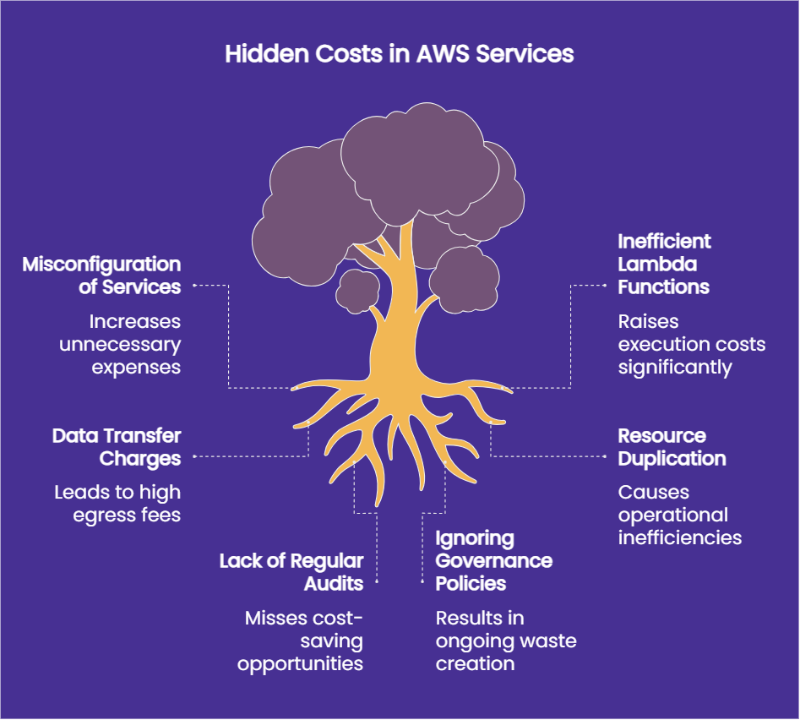
Services like Elastic IPs, NAT Gateways, and CloudWatch Logs quietly contribute to AWS bills when misconfigured. Elastic IPs incur hourly charges when not associated with running instances, creating expenses for unused network resources. NAT Gateways charge per GB of processed data, generating significant costs for high-volume applications. CloudWatch Logs pricing depends on ingestion and storage volumes, potentially creating unexpected expenses for verbose logging configurations that could inflate the cloud bill. Regular environment audits using AWS Trusted Advisor identify these often-overlooked cost sources before they substantially impact budgets.
Lambda Pricing Optimization
AWS Lambda's pay-per-use model creates hidden expenses when functions are overprovisioned or inefficiently coded. Costs accumulate based on execution time and memory allocation, with oversized memory settings unnecessarily increasing expenses. Long-running functions with inefficient code generate higher charges due to extended execution time. Regular monitoring with AWS Cost Explorer ensures functions remain optimized for both performance and cost efficiency. Organizations typically reduce Lambda expenses by 40-60% through right-sizing memory allocations and optimizing code execution paths.
Hybrid Cloud Cost Control
Hybrid architectures introduce unique cost challenges through data transfers between environments and resource duplication, complicating the management of cloud infrastructure expenses. Data movement between AWS and other providers creates high egress charges, while duplicated resources across environments lead to operational inefficiencies. AWS Direct Connect provides cost-efficient hybrid connectivity compared to internet-based transfers, reducing ongoing networking expenses. Regular monitoring ensures clear visibility into resource usage across environments, preventing unnecessary duplication. Organizations implementing centralized cost management across hybrid environments typically identify 15-25% in potential savings opportunities.
AWS cost optimization requires ongoing attention to resource utilization, service configuration, and architectural decisions. Data transfer expenses, idle resources, and misconfigurations represent the most common sources of cloud waste requiring regular attention. Implementing reserved instances, lifecycle policies, and right-sizing initiatives delivers substantial savings without impacting application performance. Organizations achieve the greatest cost efficiency by combining technical optimizations with governance policies that prevent waste creation. Cloud cost management should become an integrated part of the development and operations lifecycle rather than a periodic afterthought to optimize cloud services usage.

No comment for this article.