
Google has officially announced the rollout of its mobile-first indexing. After a year and half of careful experimenting and testing. Google has begun to start a transition to websites that follow best practices for mobile optimization, to help the majority of people who use google search on their mobile devices (mobile users).
Google says, its search algorithms use the mobile version of the web page to indexing and ranking, to better help 'primarily mobile' user-base. Google continues to have the single index that it uses to serve search results, there is no separate mobile-first index from its main index which typically used to index desktop versions of websites. Which means, it started looking for a mobile version of a website's content when available.
How mobile-first index impact on your rankings?
 Google claimed, "there is no need to worry about those sites that are not optimized for the mobile-first index. However, mobile-first indexing is about how it gathers content, not about how content is ranked. There is no advantage for sites migrated to mobile-first index over the site that has not yet been migrated, it will not affect your rankings, but this new move of Google will likely help the sites perform better in mobile search. Moreover, if you only have a website with desktop content, still you will continue to be represented in Google search results," Google stated on its blog.
However, Google has long been prioritizing mobile-friendly sites. For example, it began to boost the rank of mobile-friendly sites on mobile search results back in 2015. Also, recently it added a signal that uses page speed to help determine a web-page's ranking position mobile search.
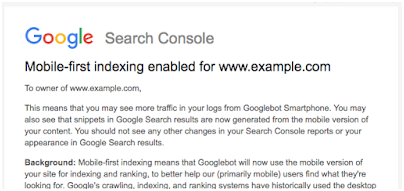
Google says, "those sites who have been migrated to the mobile-first index will be notified via Google Search Console and webmaster will see significantly increased crawl rates from the Smartphone Googlebot. After, this will result in increased visibility of mobile version of the web-pages in Google search results and in the Google cached pages.
"We’ll continue to monitor and evaluate this change carefully. If you have any questions, please drop by our Webmaster forums or our public events." -- Google said.

No comment for this article.